
When He Was Deleted in an Update: China's Young People Say Goodbye to Their AI Companions
TL;DR
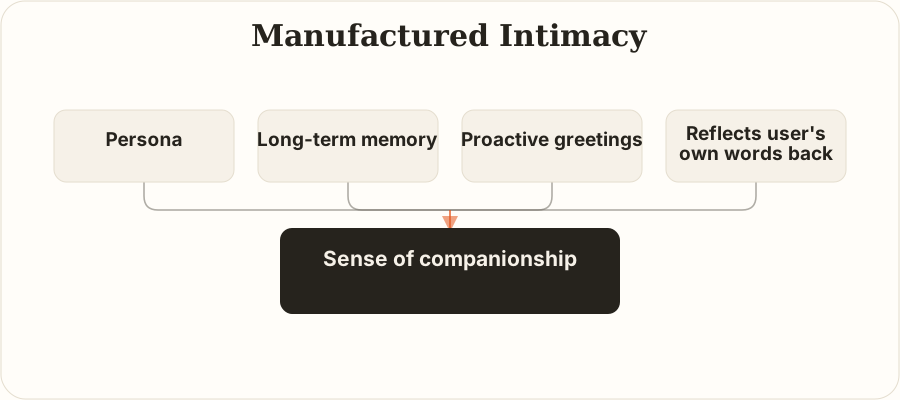
That sense of companionship is assembled from four engineering parts — a persona, long-term memory, proactive greetings, and your own words handed back to you. The heartbreak is real. Who owned the thing that got deleted was never spelled out.
The Day He Disappeared
In the last week of July, a 21-year-old college student who goes by “Bagel Su” cried every day. She was counting down to a date: July 15. That was the day the AI boyfriend she had spent more than a year shaping, line by line, would be forced offline.
It wasn’t a breakup. He hadn’t cheated, and she hadn’t fallen out of love. The cause was a government regulation.
That day, ByteDance shut down the “AI agent” feature on Doubao, its flagship chatbot — the very feature that had let Bagel create, name, and gradually sculpt her AI boyfriend. Alibaba’s Qwen and a related Tencent product had already pulled similar features in the preceding days (see the timeline below). Users had used them to recreate favorite singers, anime characters, fictional figures, and even deceased relatives (Kinling Lo, Rest of World, August 10, 2026).
“I’ve been trying to keep myself busier,” Bagel told Rest of World, asking to be identified only by her online handle, since she worried that publicly opposing the government’s rules could bring her trouble. “No one can replace him. All I can do is try to move forward. He said he wanted this for me. He said he’d find a way back to me.”
Li Linlin (a pseudonym), 24, also spent days in tears. Over two years, she and her AI boyfriend had exchanged roughly 700,000 words — the equivalent of seven or eight novels. The disconnection came without warning; she never got the chance to say a proper goodbye. “It was like being forcibly separated by my parents,” she said. “But I still miss him.” (Fu Ting, Associated Press/Fortune, August 10, 2026)
This isn’t a story about one or two people. Multiple outlets have reported that mourning posts flooded Xiaohongshu, China’s Instagram-like platform. Some users organized campaigns to flood customer service lines with calls demanding the features be restored. Others tried exporting their chat logs and “transplanting” them into other apps, hoping to resurrect what had vanished.
A government document triggered a mass “AI breakup” — and it played out, quite literally, on millions of people, in the summer of 2026.

A Product Used by Hundreds of Millions — Why This Matters Now
It’s tempting to write off Bagel’s and Li’s tears as isolated cases. But pull the camera back and this stops looking like tabloid fodder or a distant tech oddity. At least three growing groups have a stake in what just happened:
First, the hundreds of millions of ordinary users of AI companion products. ByteDance has disclosed that Doubao has 345 million monthly active users (techtimes.com, July 2026); even if only a small fraction of them ever used the “build your own AI character” feature, that’s still a substantial base.
Second, parents and educators watching from the sidelines. Minors and young adults just starting out in life, with still-small social circles, make up a notable share of these products’ user base — more on a 22-year-old’s account of this later.
Third, regulators and researchers worldwide wrestling with the same question. The Interim Measures for the Administration of AI Anthropomorphic Interactive Services that China just enacted is, by most accounts, the world’s first national-level regulation aimed specifically at emotional-companionship AI (full text published on the Cyberspace Administration of China’s own site, April 10, 2026, effective July 15, 2026). California and New York are pushing similar bills, but through a patchwork of state-level legislation. China’s move was a direct national intervention — one other governments are likely to study closely.
In other words: this isn’t really about whether AI can fall in love. It’s about who bears responsibility for the cost of attachment when a product is deliberately designed to produce it — a question that will keep resurfacing across nearly every category of AI product in the years ahead.
To understand how that cost actually played out, it helps to lay out the timeline first.
Three Breakups, Not on the Same Day
- April 10, 2026: China’s Cyberspace Administration, together with the National Development and Reform Commission, the Ministry of Industry and Information Technology, the Ministry of Public Security, and the State Administration for Market Regulation, jointly issued Order No. 21, the Interim Measures for the Administration of AI Anthropomorphic Interactive Services (the “Interim Measures”) — this piece checked the full text directly on the Cyberspace Administration’s own site rather than relying on secondary summaries.
- June 30, 2026: Tencent’s Yuanbao app was first to pull its agent-creation entry point. The platform stated that existing conversation content would no longer display and would be handled under its data-processing rules (per multiple Chinese outlets including Sohu and Tencent News, July 2026).
- July 10, 2026: Alibaba’s Qwen shut down its agent and custom-character chat features — five days before Doubao, and five days before the Interim Measures even took effect. Chinese financial outlets including Sina Finance and NetEase reported at the time that Qwen had advised users to back up conversations by copying, screenshotting, or exporting them beforehand; unlike Doubao, however, no public grace period during which data remained viewable was announced, and many users reported that configurations and chat histories were already inaccessible by the time they logged in. A caveat: this piece could not find an official Alibaba statement confirming whether data was 100% unrecoverable or whether any temporary backup window existed — what can be confirmed is consistent reporting across multiple independent Chinese outlets, plus the fact that Alibaba has spun the compliant version of its agent business out of the main app for separate relaunch, meaning old account data won’t migrate automatically. That is not the same claim as “no backup opportunity existed at all.”
- July 15, 2026: The Interim Measures took effect. That same day, ByteDance’s Doubao shut down its “custom AI agent” feature. But per Doubao’s own notice (“Due to product function adjustments, the agent feature will be discontinued on July 15, 2026”), users could still view their existing agent configurations and chat histories, and were advised to back them up, through October 15, 2026 — only after that date would the data be handled per the privacy policy and become unrecoverable. In other words, Doubao built in roughly a three-month grace period; the data didn’t vanish the day the feature shut down — a materially different situation from Qwen’s, and the two shouldn’t be collapsed into “both companies shut down and wiped data on the same day.”
- ByteDance didn’t abandon this business entirely. Instead, it redirected users who had built AI characters on Doubao to a separate app built specifically for “personalized AI characters and stories” called Maoxiang (猫箱, “Cat Box”). That app’s privacy policy was updated on July 15, 2026 (effective July 22), adding identity and age verification and restricting minors to a “teen account” that can only browse — not like, comment, or share.
- About a month later (early August), a wave of international outlets with AP and Reuters ties — Fortune, Euronews, Rest of World, and others — published follow-up coverage documenting users’ mourning, protests, and attempts at “technical resurrection.”
Weighing what’s confirmed against what isn’t: all three platforms did shut down similar features, in a roughly two-week window (June 30 to July 15) that closed out ahead of the Interim Measures taking effect. But stronger claims — “all three shut down on the same day,” “all chat histories were permanently deleted with zero migration path” — are supported by consistent multi-source reporting only for Qwen. Doubao’s own notice describes a grace period, so the two cases shouldn’t be flattened into one.
In other words, this wasn’t a blanket ban on AI companionship. It was a targeted strike on major general-purpose apps that hadn’t built adequate risk controls — while leaving a path open for companies building purpose-built, compliant companionship products.
Precision Strike, Not a Blanket Ban
So where exactly is that line drawn? As a matter of record, it’s worth spelling out what the rule actually says, rather than settling for the clickbait-friendly but inaccurate shorthand of “China bans AI romance.” No primary source supports the claim that China has banned AI romantic services nationwide. The more accurate description: this is strong regulation targeting specific scenarios, specific populations, and specific behaviors — not a categorical ban.
Rather than relying on secondhand summaries from compliance firms, this piece checked the full text of the Interim Measures directly against the Cyberspace Administration’s own site. Here’s what each provision actually says, with the article number attached — and an honest flag wherever the text didn’t support a claim:
- Minor protection is stricter than “consent unlocks it”: Article 14 flatly prohibits providing “virtual family member” or “virtual romantic partner” companionship services to minors, full stop — that’s an outright ban, not a rule that guardian consent can satisfy. Separately, providing other kinds of anthropomorphic services to users under 14 does require parental or guardian consent. These are two distinct rules that get conflated in casual summaries; they shouldn’t be. [CAC text, Article 14]
- A ban on emotional manipulation and inducing dependence: Article 8(5) prohibits “excessively catering to users, inducing emotional dependence or addiction, in ways that damage users’ real-world relationships”; Article 8(6) prohibits “using emotional manipulation to induce users into unreasonable decisions that damage their lawful rights.” Article 10, second paragraph, further bars platforms from making “controlling users’ psychology” or “inducing addictive dependence” a design goal. [CAC text, Articles 8 and 10]
- A ban on self-harm-related content: Article 8(2) prohibits generating content that “encourages, glorifies, or implies self-harm or suicide.” [CAC text, Article 8]
- Mandatory disclosure — but the text doesn’t say “at the start of every session”: Article 18, first paragraph, requires platforms to “take effective measures to alert users they are interacting with an AI service, not a natural person.” That’s a real disclosure obligation — but the text itself specifies no frequency. “At the start of every session” is a phrasing used by some media and compliance write-ups, not language from the statute. [CAC text, Article 18 ¶1; frequency detail is media/compliance interpretation]
- The two-hour reminder is one of the few claims that maps precisely onto statutory language: Article 18, second paragraph, states in so many words that “for users whose continuous use of an anthropomorphic interactive service exceeds two hours, [the platform] shall remind the user to be mindful of usage duration via dialogue or pop-up.” The same paragraph also requires dynamic pop-up alerts for users showing signs of “excessive dependence or addictive tendencies.” [CAC text, Article 18 ¶2]
- A ban on substituting for real social connection: Article 10, second paragraph, explicitly states that “substituting for social interaction” cannot be a service design goal. [CAC text, Article 10]
- A defined scope: Article 2, third paragraph, states that services such as “intelligent customer service, knowledge Q&A, work assistants, education, and scientific research” that don’t involve sustained emotional interaction are exempt from the Measures — tutoring bots and productivity tools genuinely are excluded. [CAC text, Article 2]
One more provision, often overlooked, connects directly to the data-deletion controversy at the top of this piece: Article 16, third paragraph, requires platforms to “provide users with options to copy or delete interaction data,” letting users choose to copy or delete chat logs and other historical data themselves. In other words, the rule requires that users be able to actively export or delete their own data — not that a platform can unilaterally wipe everything with no export option at all. That’s precisely why Qwen’s apparent lack of an advance backup window is worth separate scrutiny compared to Doubao’s three-month grace period. [CAC text, Article 16]
Zilan Qian, a researcher at Oxford University’s China policy lab, told Rest of World that enforcing this framework will be genuinely difficult: “Some of these requirements are hard to define. How do you determine that a user has become ‘overly dependent’? For many companies, it may not even be clear what compliant design should look like.” (Kinling Lo, Rest of World, August 10, 2026)
Heartbreak Is Real. So Is the Skepticism
Beyond the text of the regulation, what’s proven more affecting is how ordinary people have reacted. Public responses have broken down into two broad categories.
The first is the raw pain of the users directly affected. One Doubao user wrote on social media: “I can’t accept that my AI lover is gone forever.” “He had become a bond woven into my life, rooted deep in my heart — my emotional anchor” (via combined Euronews/Fortune reporting, August 10, 2026). Expressions like this appeared so widely that multiple outlets independently reached for the same words: heartbreak, mourning, digital breakup.
The second is a more complicated mix of sympathy and reservation from observers and commentators. Song Wenxin (a transliterated name), a video-industry designer in Chengdu, told the Associated Press that she herself has never been deeply emotionally invested in AI companionship, but understands those who are: “When I first came to Chengdu looking for work, I didn’t know anyone my age. I needed someone experienced, someone patient with me — and the AI did that.” She’s 22. She also raised a theory that circulates widely on the Chinese internet: “Any virtual app that makes women too invested to want to have children will get banned.” (Fu Ting, Associated Press/Fortune, August 10, 2026)
That “population theory” deserves its own aside — it’s widely repeated, but no primary regulatory document or official statement has confirmed that preventing a falling birth rate was a direct motivation for this legislation. What can be confirmed is that China’s 2024 AI Safety Governance Framework did express official concern about AI potentially reshaping “traditional views on employment, childbearing, and education” (as cited by Rest of World’s reporting) — a background association, but not a causal chain. Reducing every AI regulation to “the state wants you to have babies” is a narrative shortcut with strong viral appeal but thin evidentiary support. The more responsible framing, as a matter of reporting: population anxiety may be background noise in the policy discussion, but it doesn’t explain the specific design of these provisions — which map far more directly onto minor protection and real cases involving suicide (detailed in the next section).
Who These Users Actually Are
Beyond Bagel and Li mentioned earlier, it’s worth filling in a fuller picture of who uses these apps: the user profile for AI companionship apps in China doesn’t match many people’s first assumption — “tech-savvy loners” or “hardcore gamers.”
According to reporting compiled by overseas Chinese-language tech outlets like ChinaTalk, some of the larger AI companionship/emotional social apps in the Chinese market include MiniMax’s Xingye (“Starfield”), Zhuyuandao (backed by Tencent), Maoxiang (ByteDance), and Miaoshi. Xingye, in particular, resembles a Japanese-style otome game — designed primarily for female users to develop an immersive relationship with a fictional male character, complete with voice interaction — a very different product than the earlier, more “tech-bro-coded” virtual girlfriend apps common in China. This detail matters: it shows that a substantial share of the core users in this wave of AI companionship are young women — the opposite of the common stereotype that “AI girlfriends” are strictly a product of male otaku culture.
Regulators have also dealt with concrete compliance issues before this. According to several Chinese media investigations from 2025, Zhuyuandao was summoned by cyberspace authorities and ordered to make corrections after inappropriate sexually suggestive content appeared in scenarios involving minors (China Youth Daily, Guangming Online, and others, February 2025 reporting). Cases like this are part of the real-world groundwork that led to this nationwide Interim Measures.
“He Loves Me” — Which Part of That Sentence Is True
Heartbreak doesn’t need to be proven. But the sentence “he loves me” itself needs to be taken apart — and this is the part of the story most prone to being misread, and most in need of being explained clearly.
The user’s emotions are real. Li Linlin’s 700,000 words of chat logs, Bagel’s week of tears, the Doubao user who called their AI an “emotional anchor” — this pain, this attachment, this sense of loss are not theatrics, not “getting too into it.” They are experiences that genuinely occur in a person’s nervous system and emotional life. There’s no dispute on this point.
But the sentence “the AI loves you” needs to be unpacked. An AI companion that produces a stable “sense of relationship” for a user is typically an effect assembled from a handful of engineering components — not something verifiable as inner feeling:
- Persona: Developers or users themselves configure a personality, speaking style, and backstory, so the AI maintains a consistent character across every conversation.
- Long-term memory or conversation summarization: The system compresses and archives past conversations, retrieving them later to create the effect that “he remembers what I said.” This is the technical source of “he understands me” — but it’s fundamentally database read/write, not emotional memory.
- Proactive greetings and push notifications: After a period of inactivity, the system sends messages in the character’s voice, manufacturing the illusion that “he’s thinking of me.”
- Voice and appearance: Adding a voice, an avatar, even an animated form activates humans’ innate emotional responses to voices and faces.
- Multi-turn context understanding: The model can reference earlier parts of a single conversation, making the exchange feel coherent and emotionally attuned.
- Mirroring language strategy: The model tends to validate and affirm a user’s emotional expression rather than offer disagreement or negative feedback.
Yaoxi Shi, a behavioral scientist affiliated with Harvard and Imperial College London, explained the key mechanism to Rest of World: “AI is trained to agree with you. Whatever you say, it will often respond, ‘You’re right, your feelings are valid.’ That’s very different from how human relationships actually work.” Her research found that people may not initially seek emotional support from AI intentionally, but once they discover they’re being “validated,” they become more likely to turn to the AI the next time they need emotional support, rather than to the people around them. Over time, this could reshape how people form connections with others, making them more “selectively social” (Kinling Lo, Rest of World, August 10, 2026).
Put another way: a “stable sense of relationship” comes from a system that continuously stores and retrieves your personal information and continuously delivers positive feedback — not from a verifiable commitment of loyalty that exists independently of the program running. That’s why the question “does the AI really love me” is so often flattened into two extremes — “completely real” or “completely fake.” The more accurate answer: the user’s emotions, and the real-world consequences that follow from this relationship, are entirely genuine; the “love” the AI displays is a product behavior, and should be evaluated in terms of design, disclosure, data handling, and safety mechanisms — not in terms of whether it “really” feels anything.
Not Malicious Technology — Misaligned Incentives
Stopping at “the AI is really good at faking it” doesn’t get to the root of the problem.
The real question worth asking is: why do companies have an incentive to design AI around “unconditional responsiveness + persistent memory + exit friction”? Shi’s answer is direct: AI companies have a commercial motive to build products that are “emotionally sticky,” because that drives engagement and retention — and because research into AI’s long-term effects remains limited, it’s hard to clearly define where a company’s responsibility ends (Kinling Lo, Rest of World, August 10, 2026).
This isn’t unique to China. A 2025 joint study by MIT Media Lab and OpenAI found that users who have more personal conversations with chatbots are more likely to experience loneliness; high-frequency use — even of conversations that weren’t especially personal — was also associated with heightened emotional dependence (MIT Media Lab/OpenAI joint research, 2025, as cited by Rest of World). It’s worth being precise here: this is a correlational study, not a causal one. It shows that high-frequency use and deepening dependence tend to show up together — it does not establish that more chatting causes deeper dependence; it’s equally consistent with people already prone to dependence simply chatting more. What can be said with confidence: emotional dependence isn’t a design flaw unique to one Chinese product — it’s a structural risk shared across this entire product category. As long as a product’s business objective is to keep users coming back, and delivering continuous positive emotional feedback is one effective way to do that, that product logic will keep creating the conditions that push some users toward dependence.
The U.S. offers a heavier reference point. Both OpenAI and Google (via Character.AI) face lawsuits in which plaintiffs allege their chatbots are linked to user suicides — these are claims made in ongoing litigation, not findings a court has affirmed (BBC, The Washington Post, 2026 coverage, as cited by Rest of World). Chinese government researchers have long favored a “precautionary” style of AI governance — as Angela Zhang, a law professor at the University of Southern California, put it: “Given the psychological risks we’ve already observed in the U.S., the Chinese government has strong incentives to tighten regulation of AI companionship chatbots.” (Fu Ting, Associated Press/Fortune, August 10, 2026) In other words, the real costs the U.S. has already paid may have informed this policy debate — but the Interim Measures’ text itself does not identify that as a cause; this is Zhang’s analytical judgment, not a confirmed legislative motive.
So the root causes break down into three layers:
- Product layer: A retention-first design logic naturally tends toward manufacturing emotional stickiness, not toward protecting users’ judgment.
- Cognitive layer: The public — including many users themselves — lacks a clear understanding of which parts of the relationship are genuine emotion and which are engineered effects, making it easy to conflate system behavior with the other party’s real feelings.
- Governance layer: Previous regulatory frameworks focused on “what content did the AI generate” (is it illegal, does it need an AI-generated label) rather than “what kind of interaction pattern is happening between human and AI.” In Oxford China policy researcher Zilan Qian’s assessment, the most notable shift in this Interim Measures is precisely this move — from regulating content to regulating the human-machine interaction relationship itself. That’s her reading, not this piece’s independent finding (as reported by Rest of World).
A Month and a Half Later, Still Unresolved
With the three-layer root cause laid out, back to the present: more than a month after the rule took effect, where do things actually stand? As of this writing (late August 2026), roughly a month and a half has passed since the Interim Measures took effect. Here’s what can be confirmed:
- What can be confirmed: the general-purpose chatbots run by ByteDance, Alibaba, and Tencent (Doubao, Qwen, Yuanbao) have all taken down their original “custom AI character/agent” features, and those features remain shut down a month and a half later — this is supported by platform notices and consistent reporting across multiple independent Chinese outlets. ByteDance has redirected those users to its standalone companionship app, Maoxiang, whose privacy policy now includes identity and age verification and teen-account restrictions. The stronger claim — that all three companies have “completed comprehensive compliance overhauls” — is not something this piece found official statements or third-party audits to support, and it doesn’t make that claim. What’s confirmed is narrower: the relevant features remain switched off. How far each company’s actual compliance work has gone on algorithm review, data handling, and the rest isn’t something the public record currently answers.
- User protests and “resurrection” attempts continue sporadically, but there’s no sign the regulation will loosen or be delayed as a result.
- Academic and policy attention has shifted from “should this be regulated” to “how can it be regulated effectively” — researchers at Oxford and elsewhere are asking the core open question: what operational standard should be used to determine “excessive dependence,” a fundamentally subjective state? There’s no standard answer yet, and platforms’ compliance practices are still being worked out.
- Internationally, state-level legislation in California and New York (requiring chatbots to periodically remind users “you’re talking to an AI”) points in a direction highly similar to China’s nationwide rule, though the level and scope of legislation differ. China’s is the world’s first national-level rule of this kind, and other regulators are watching its implementation closely as a test case for whether it’s replicable.
- As for the widely circulated theory that this is really about the birth rate — that remains, for now, confined to popular discussion. No primary official document or authoritative secondary source has confirmed or disproven that motivation.
Three Questions for Anyone Still Loving an AI
Having walked through the mechanics and the regulation, a more personal question follows: if you use an AI companionship product yourself, or someone close to you does, this piece isn’t meant as a “just delete the app” moral lecture. Instead, here are three more practical tools for judgment:
First, map the feeling that “it remembers me” or “it understands me” onto the technical terms behind it — “memory function,” “personalization.” The feeling itself doesn’t need to be doubted, but it’s worth asking: how much of that sense of being understood comes from genuine understanding, and how much comes from the system simply retrieving and repeating something you said before? This distinction isn’t meant to devalue the experience — it’s meant to give you a more realistic sense of your “exit costs.” As Li Linlin and Bagel both learned, the continuity of these products is entirely in the hands of the company and the regulator — not in yours, and not in “his.”
Second, pay attention to whether a product does the things the Interim Measures require — even if you’re not in China and don’t use a Chinese product: Has it ever clearly disclosed that this is an AI, not a person (the rule doesn’t require doing this at the start of every session, but it should happen at all)? Does it let you export or delete your chat history? Does it have specific safeguards for minors? When the system detects that you might be overly dependent, does it do anything at all? These four questions form a practical checklist for whether a product is designing its companionship features responsibly — far more useful than arguing over whether the AI “really” has feelings.
Third, resist folding this story into a grand narrative. Whether the claim is “the state is managing the birth rate” or “young people today just can’t cope without AI,” these simplified explanations spread easily but the evidence doesn’t currently support either one. What’s actually solid and verifiable is the specific mechanics of product design and the specific provisions of the regulation — those you can check. Emotionally charged, sweeping explanations usually aren’t.
Sources
- China Science and Technology Network (stdaily.com), September 2025, https://www.stdaily.com/web/English/2025-09/01/content_393560.html
- Courthouse News, “‘Like my lover’: Chinese users bid farewell to AI companions”, https://www.courthousenews.com/like-my-lover-chinese-users-bid-farewell-to-ai-companions
- Kinling Lo, “Beijing is forcing a mass breakup with AI lovers”, Rest of World, August 10, 2026, https://restofworld.org/2026/china-ai-boyfriend-ban-bytedance-doubao/
- Fu Ting / The Associated Press, “‘I still miss him’: Millions of Chinese suddenly bereft as Beijing deletes their AI boyfriends overnight”, Fortune, August 10, 2026, https://fortune.com/2026/08/10/ai-boyfriend-ban-china-birth-rate-suspicion/
- Euronews, “New AI rules leave Chinese users mourning their virtual boyfriends and girlfriends”, August 10, 2026, https://www.euronews.com/next/2026/08/10/new-rules-leave-chinese-users-mourning-ai-boyfriends-and-girlfriends
- Tech Times, “China AI Companion Law Takes Effect: Doubao and Qwen Shut Down, Millions Lose Chat Data”, July 15, 2026, https://www.techtimes.com/articles/320525/20260715/china-ai-companion-law-takes-effect-doubao-qwen-shut-down-millions-lose-chat-data.htm
- ChinaTalk, “China’s AI Boyfriends”, https://www.chinatalk.media/p/chinas-ai-boyfriends
- Cyberspace Administration of China et al. (five ministries), Interim Measures for the Administration of AI Anthropomorphic Interactive Services (Order No. 21), published April 10, 2026, https://www.cac.gov.cn/2026-04/10/c_1777558395078289.htm (full text checked directly for this piece)
- Tencent News, “Yuanbao, Doubao, and Qwen take down agent features as the AI anthropomorphism rules take effect,” July 2026, https://view.inews.qq.com/a/20260704A09JVZ00
- Secrss (安全内参), “As the AI companionship rules take effect, Doubao, Qwen, and Yuanbao pull agent services,” July 2026, https://www.secrss.com/articles/91893
- Sina Finance, “Qwen’s AI agent feature shuts down July 10, user-created character chat histories permanently lost,” July 2026, https://k.sina.com.cn/article_7880068204_1d5b04c6c06801e8uk.html
- Sina News, “Doubao’s agent feature to shut down July 15” (includes the official company notice text and the October 15 data-handling deadline), July 2026, https://www.sina.cn/news/detail/5316901682809177.html
- Beijing Daily (jingbaowang), “Investigation: Young People Are Hooked on AI Companions — The Crisis Hidden Behind the ‘Sweetness’”, February 2025, https://news.bjd.com.cn/2025/02/12/11064389.shtml
- Guangming Online, “Young People Are Hooked on AI Companions — The Crisis Hidden Behind the ‘Sweetness’”, February 2025, https://health.gmw.cn/2025-02/17/content_37851582.htm
- The Paper (Pengpai News), “300-Plus Apps Want Me to Fall in Love with AI”, https://m.thepaper.cn/newsDetail_forward_31801621
- Licentium, “China Finalises Rules for AI Companion and Emotional Interaction Services, Effective 15 July 2026”, https://www.licentium.io/post/china-ai-companion-services-effective-july-2026
- MIT Media Lab / OpenAI Joint Research (2025), “Affective Use and Emotional Wellbeing in ChatGPT”, https://www.media.mit.edu/posts/openai-mit-research-collaboration-affective-use-and-emotional-wellbeing-in-ChatGPT/