
A Plain-English Guide to Talking to AI Well
TL;DR
A high-quality conversation doesn't come from one magic prompt. It comes from deciding what to hand over, saying plainly what you want, checking whether the answer is actually backed by evidence, and owning the result once it ships. That's the 4D framework.
In the last piece, we covered this: a large language model generates language step by step from context, which is why it’s so good at writing and explaining — and also why it can state an unsupported judgment as if it were a complete, settled fact.
So talking to AI is nothing like using a search box.
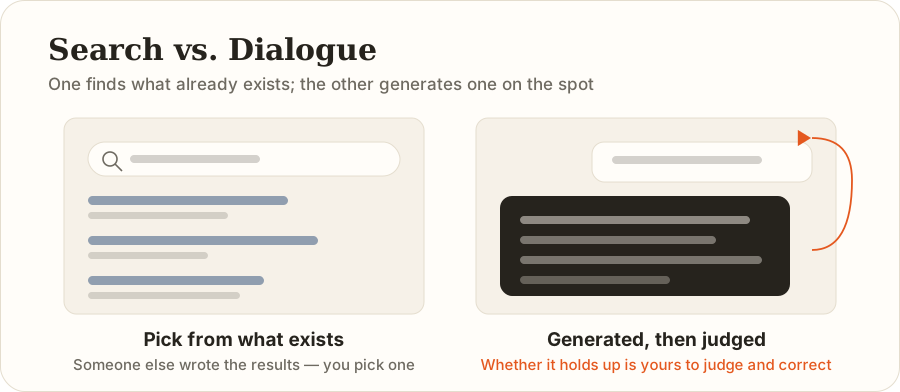
A search box works like this: you type keywords, and the search engine surfaces pages that already exist. Your job is mostly to judge which result is worth reading, and those pages were mostly written and edited by people. A conversation with a large language model is different. It isn’t a database stocked with pre-verified answers. It generates text step by step, based on context, learned patterns, and probability. It can organize material, rewrite text, extract relationships, and generate candidate options for you — and, once connected to tools, carry out authorized actions — but none of that is the same as human understanding, intent, or judgment.
What that means is: AI generates an answer dynamically based on your input, and that one-off answer’s soundness and accuracy depend on you — to weigh in, correct, and refine. It turns into a process of solving the problem together with AI.
Once you get that distinction, you’re ready for the next stage:
First, AI is not an answer machine that thinks for you — it’s a collaborator that needs to be assigned the right part of the job.
Second, a high-quality conversation isn’t the product of one magic prompt landing perfectly — it comes from clarifying the goal, dividing up the work, iterating together, and checking the result.
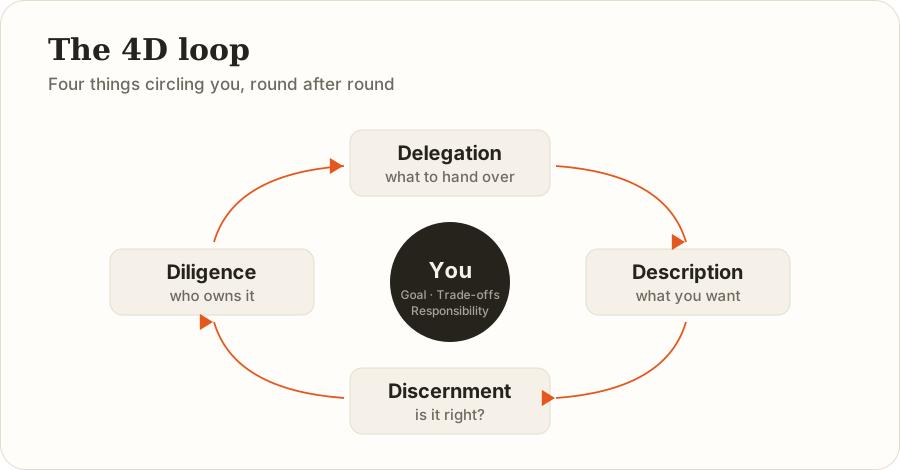
Here’s a framework worth adopting: AI Fluency, developed by professors Rick Dakan and Joseph Feller, with Anthropic partnering on a public course built around it. Its core is four D’s — Delegation, Description, Discernment, and Diligence — the 4D framework.
Picture working alongside a teammate. The questions you’d naturally ask are the same ones that apply here: what can I actually hand off to them? How do I explain it so they know exactly what I need solved? Why should I trust the result? And who’s accountable if it goes wrong?
1. Delegation: Decide What to Hand to AI First
Delegation means dividing up the work first, then handing off the part that makes sense to hand off.
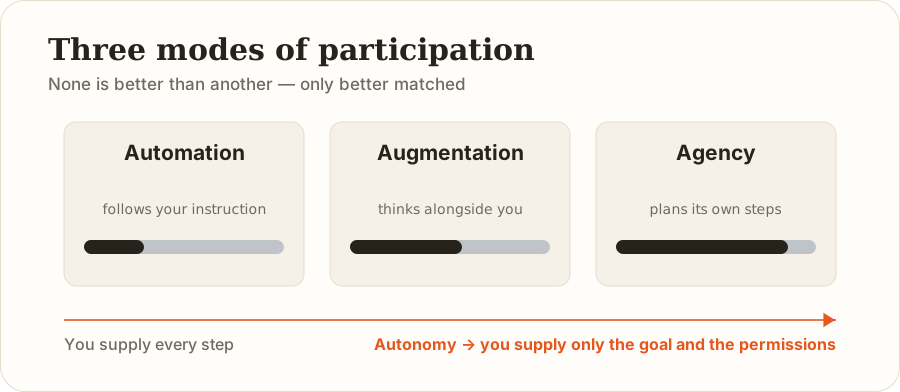
AI can be involved in three different modes:
- Automation: AI carries out a clearly specified task — rewriting a paragraph, cleaning up meeting notes.
- Augmentation: AI extends what you can do — comparing several options, helping you learn a new concept.
- Agency: you give the system a goal and some level of authority, and it plans its own steps, calls tools, and drives the task forward.
None of the three is inherently better than the others — what matters is whether the task and the level of authority you’ve granted actually match.
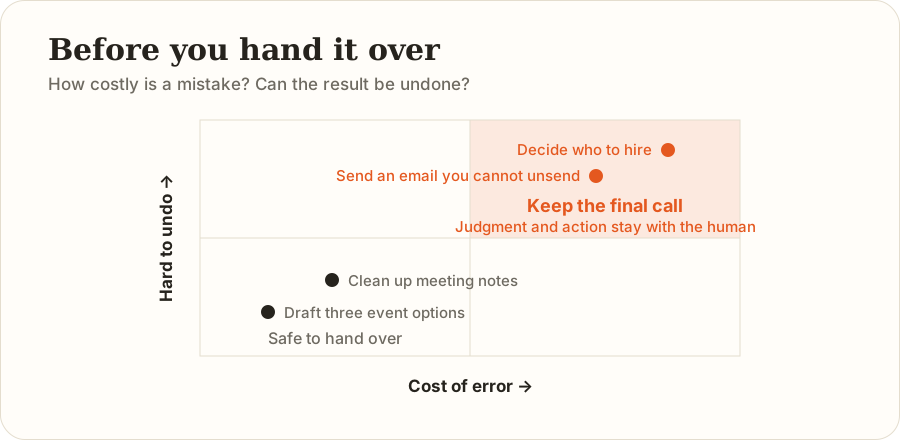
When deciding how to divide the work, start with two questions: how costly is a mistake, and can the result be undone?
Have AI propose three event ideas — if it gets it wrong, you just try again. But if the decision is whether to hire someone, or sending an email that can’t be unsent, the final judgment and the action itself need to stay with a person.
Take designing an AI training program as an example: you might have AI list the problems employees are likely to run into, then propose three possible course structures, and compare the learning curve and rollout difficulty of each. But which one to actually go with is still your call.
The tool can do more of the work for you — it can’t decide whether the work is worth doing.
2. Description: Say Out Loud What’s in Your Head
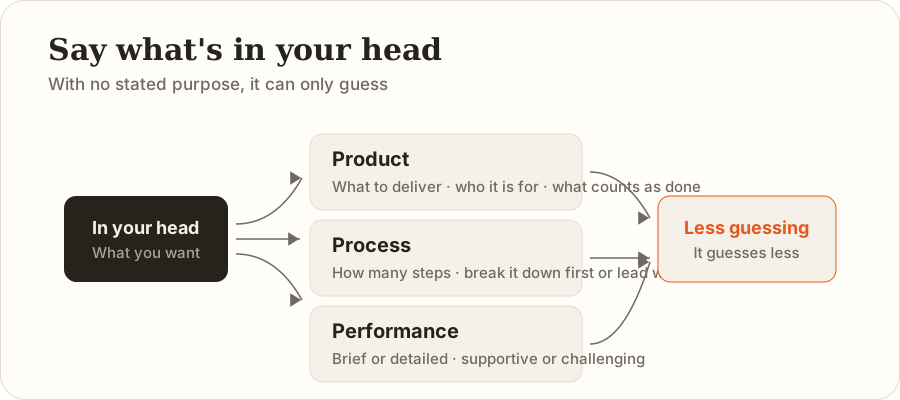
“Help me write a project proposal” sounds clear enough, but it could actually point to five completely different outputs: a decision memo for your boss, an execution plan for your team, a pitch deck for a client, a business case for investors, or just a rough draft to help you think. Different purposes call for different writing. If the purpose isn’t specified, AI has to guess.
To get what’s in your head across clearly, think in terms of three angles: Product, Process, and Performance.
Product: What You Need to End Up With
Spell out who the result is for, what format it needs to be in, what it absolutely must include, and what counts as “done.”
For example:
I'm designing an internal AI training program for a retail company
with about 200 employees. The goal is to help staff with no coding
background use AI to organize materials, summarize meetings, and do
preliminary research. The program needs to start a pilot run within
three months.

Please start by proposing three possible course structures, comparing
learning curve, rollout difficulty, and potential risk for each.
Don't assume the company has already standardized on a single AI tool,
and don't fabricate training outcome data.
Start with a comparison table and a list of questions you need me to
decide — don't jump straight to a complete plan.
Process: How You Want It to Move Forward
A complex task doesn’t need to be written in one pass. You can have it break the problem down and lay out the evidence first, then form a judgment — or propose a direction first, then compare resources, payoff, risk, and dependencies.
When researching a new market, you might ask it to first list the research questions and what evidence it needs, distinguish primary sources from media coverage from inference, and only write the conclusion at the end. The goal should be specific; the process can flex. It doesn’t need to be locked down like a fixed itinerary.
Performance: Spell Out How You Want It to Interact With You
Product is about what to produce. Process is about how to get there. Performance covers a third thing entirely: how you want it to work alongside you.
This is the one people skip most often, mostly because it never occurs to them that it’s adjustable. But think back — has AI ever handed you eight hundred words when all you wanted was one sentence? Have you ever floated an idea with an obvious flaw in it, only to have it cheer you on anyway? Neither of those is a sign it isn’t smart enough — it’s that you never told it otherwise. Left unspecified, its default assumption is that you want something pleasant to read.
There are roughly three dials you can turn:
- Concise or detailed: give you the conclusion straight up, or lay out the full reasoning?
- Supportive or challenging: help you run with an idea, or actively hunt for the holes in it?
- Ask first or act first: when information is missing, ask before proceeding, or fill the gaps with its own assumptions and go?
Spelling this out only takes a few lines:
This is an early-stage idea I haven't fully thought through yet.
Please act as a critic first: point out the three weakest parts of
this idea before mentioning anything positive.
Give me bullet points only — don't expand into a full essay.
If my underlying premise is flawed, say so directly. Don't just go
along with it.
But keep one distinction straight: Performance controls stance and tone — not what the model actually knows. “Answer as if you’re a world-leading expert” is a popular trick, but that kind of role-play doesn’t give AI a single additional fact. It can shift the angle it looks at a problem from — it cannot substitute for real sources, real material, or your own verification.
At the end of the day, AI isn’t a database, and it isn’t a vending machine — it’s a collaborator that works with you the way you tell it to.
3. Discernment: Sounding True Is Not the Same as Being Backed by Evidence
The most underrated of the 4D’s is Discernment — the ability to evaluate and judge what you’re given.
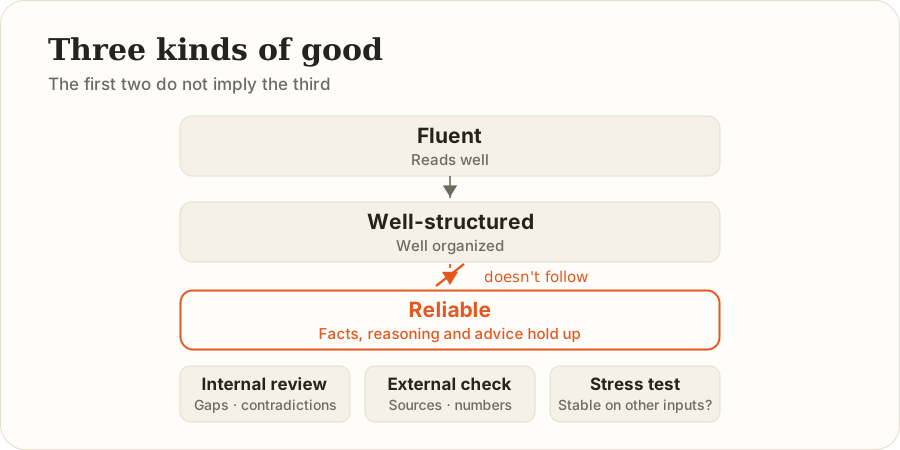
An AI answer can be “good” in three different ways:
- It’s well-written;
- It’s well-organized;
- Its facts, reasoning, and recommendations actually hold up.
The first two do not automatically imply the third.
A report can be beautifully written simply because the model is skilled at constructing sentences — that tells you nothing about whether the underlying numbers are current.
So checking can run along the same three angles — Product, Process, and Performance:
- Product: Is the result accurate, on-target, and appropriate for the audience, format, and real-world constraints?
- Process: Did it skip a critical step, treat an assumption as a fact, or draw a conclusion from insufficient evidence?
- Performance: Was the interaction appropriate? Did it simply agree with everything, paper over uncertainty, or make a decision on your behalf without authorization?
Of the three, Product takes the most work to verify. Once you have AI’s output in hand, check it against three layers:
| Check Layer | What It’s Mainly For |
|---|---|
| Internal review | Catching omissions, contradictions, flawed assumptions, and missing counterarguments |
| External verification | Confirming sources actually exist, numbers actually add up, and code and links actually work |
| System testing | Checking whether the result holds up under a different input, version, or edge case |
It’s especially easy to skip verification when AI produces a polished plan, a complete-looking report, or an explanation that sounds thoroughly professional. A 2025 study by Microsoft Research and Carnegie Mellon University on knowledge workers found that AI shifts part of people’s work away from gathering and directly producing information, and toward verifying information, synthesizing responses, and overseeing tasks — and that the more confidence people had in AI, the less critical thinking they tended to apply.
So when you’re facing a fluent answer, ask at least four questions: Did it actually answer my real question? Which parts are facts and which are inferences? Did it skip a critical step? Does this result actually fit my team, my budget, and my situation? A fact should trace back to material, a source, or a calculation you can reproduce; an inference can be valuable, but it should never be dressed up as a fact.
Some people have tried having AI check its own work. That approach is decent at catching omissions, improving structure, and surfacing counterexamples — but it is not a substitute for external verification. The same model can be inclined to validate its own answer, and some research has found that models actually amplify this self-favoring bias when revising their own output.
Discernment isn’t about doubting every word AI produces — it’s about knowing where you can treat it as a thinking partner, and where you absolutely need to bring in outside evidence.
4. Diligence: Owning the Choice, the Disclosure, and the Delivery
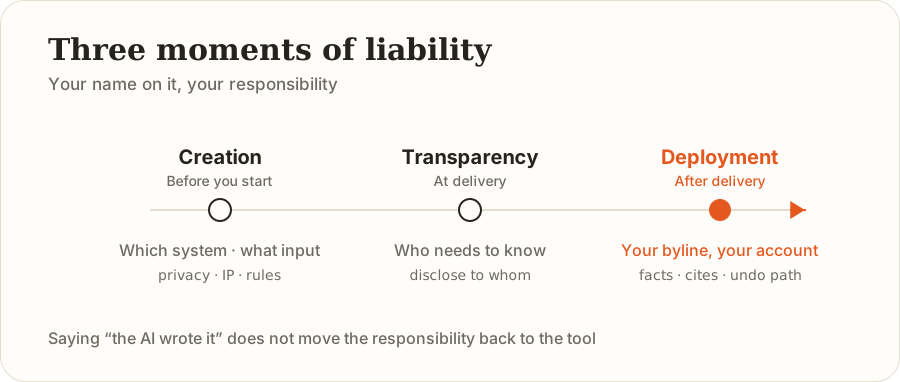
Diligence covers everything from how you choose to use AI to how you deliver the final result — the consequences at every stage are yours to account for.
Creation Diligence: Choose Carefully How You Use It
Before you start, think through: which system you’re using, what material you’re feeding it, and whether you’re automating the task or working through it together. Privacy, confidentiality, intellectual property, organizational policy, and task risk all belong to this judgment call.
A spreadsheet with customer contact information shouldn’t get uploaded to just any tool simply because AI can process it fast. Confirm first whether the data is even allowed to leave your systems, and strip out identifying details if you need to. For high-risk tasks, you can let AI sort and shortlist candidates, but keep the actual decision in your own hands.
Transparency Diligence: Let the People Who Need to Know, Know
If AI played a part in a report, a course, a design, code, or a decision memo, who needs to be told — and how much detail they need — depends on organizational policy, what the output is being used for, and how heavily AI was involved.
A draft AI generates that a human then supplements with real material and verifies is not the same process as submitting something straight out of the model without checking it. Don’t let an unverified judgment get mistaken for something that went through real professional review.
Deployment Diligence: Own the Result After It Ships
The report has your name on it. The email went out from your account. The code is live. The article is public. None of that responsibility transfers to “the tool” just because AI wrote part of it.
Before delivery, check the facts, the citations, privacy, copyright, and anything a tool returned. Once an agent is involved, also check external state, logs, and whether an action can be reversed.
You signed it. You own it.
5. Putting the 4D’s to Work in Four Everyday Tasks
Scenario One: Doing Research
A low-quality request looks like:
Help me research this market.
Try this instead:
- Delegation: Build me a research map, gather material, and raise open questions — don’t jump to a conclusion for me yet.
- Description: Research the U.S. market, scope: the last three years, audience: company leadership, purpose: deciding whether to enter.
- Discernment: Separate fact from source opinion from inference from recommendation; flag anywhere the evidence is thin.
- Diligence: Trace key numbers back to their original source — don’t treat a media summary as a primary source.
Build the map first, then fill in material, then look for the counter-case, and only then form a judgment.
Scenario Two: Learning Something New
A low-quality request looks like:
Explain quantum computing to me.
Try this instead:
My goal is to build an understanding I can actually explain back in
my own words, not just memorize definitions.
I have no technical/engineering background.
Start with an everyday analogy, then explain exactly where that
analogy breaks down.
For every concept, explain what problem it solves and what
misunderstanding people commonly have about it.
At the end of each section, ask me a question to check whether I can
restate it myself.
- Delegation: Have AI handle the explaining, the quizzing, and the correcting — it doesn’t get to decide whether I’ve actually learned it.
- Description: State your starting point, your goal, and how much time you have.
- Discernment: Test whether you can restate it yourself, and cross-check against a textbook or reliable source.
- Diligence: If this feeds into an exam, a paper, or a professional conclusion, follow the relevant rules and disclose AI’s involvement.
Scenario Three: Designing a Project Plan
A low-quality request looks like:
Just write me a complete project plan.
Break it into rounds instead:
Round one: help me pin down what the actual problem is.
Round two: propose three possible directions — don't pick one for me yet.
Round three: find the most likely failure point in each direction.
Round four: based on the direction I choose, put together a full plan.
Round five: review the plan from the perspective of someone opposed to it.
- Delegation: Have AI expand your options, weigh the trade-offs, and hunt for failure points.
- Description: Give it your team, budget, timeline, existing systems, and definition of success.
- Discernment: Check whether the plan actually answers the real problem, and whether its assumptions are backed by evidence.
- Diligence: You decide whether it’s worth doing, and you own whatever plan finally gets submitted.
Scenario Four: Managing Your Own Tasks
A low-quality request looks like:
Plan out my workday for me.
Try this instead:
Using the task list below, organize my schedule for the week.
Distinguish between importance, urgency, dependencies, and estimated
time for each task.
Don't remove any tasks on your own, and don't assume any meeting can
be canceled.
If there isn't enough time for everything, list out where I need to
make a trade-off.
Give me output organized by date, along with any conflicts, anything
pushed back, and any decisions you need me to confirm.
- Delegation: Have AI lay out candidate schedules — it doesn’t get to make the trade-off calls for you.
- Description: Provide deadlines, time estimates, dependencies, and anything that can’t move.
- Discernment: Check whether the plan is actually workable and whether it missed a conflict.
- Diligence: If the system can actually modify your calendar, send messages, or update task status, confirm permissions first, then verify the action actually happened.
The task changes, but your role doesn’t: hand off whatever can genuinely be delegated to AI, and keep the goal, the trade-offs, and the responsibility with yourself.
6. Beyond the 4D’s: The 3S’s
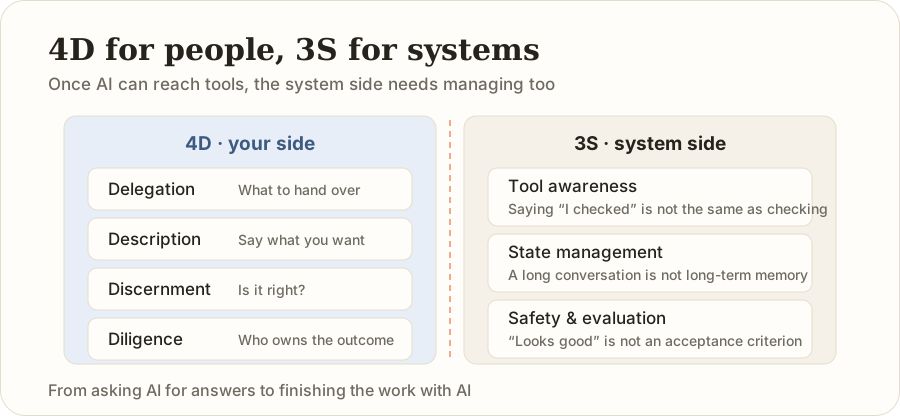
The 4D’s are about the human side: what gets handed to AI, how you make the ask clear, how you judge the result, and who’s accountable. But today’s AI can also connect to search, files, code, calendars, and outside services — so there are three more things to watch on the system side.
These three points sit outside the original 4D framework — they’re observations we’ve added based on working with agents in practice.
Tool Awareness: Know Where the Capability Is Actually Coming From
Keep the model, retrieval, code execution, the file system, external APIs, and agents conceptually separate.
If the model says “I already checked,” that doesn’t mean a search tool actually returned real results. If it says “the file has been created,” that doesn’t mean the file actually exists.
State Management: Know Where the Progress Actually Lives
A long conversation is not the same thing as long-term memory. You need to know what material is actually present in the current conversation, what’s left over from an earlier version, which assumptions have already been overturned, and where progress is actually being saved.
A project that runs for weeks can’t rely on a single chat thread. Stage summaries, version markers, task lists, and handoff documents are what let the next session pick up where the last one left off. This kind of work is often called Context Engineering.
Safety and Evaluation: Make “Done” Something You Can Actually Verify
An important task shouldn’t be signed off on just because it “looks fine.”
If an agent can read files, run code, or send emails, you need to check what tools it called, with what parameters, and what state actually changed. Actions like deleting, sending, or paying need a higher bar for confirmation. When material is insufficient, permissions are missing, or completion can’t be proven, the system should stop and report back rather than push forward.
Running something multiple times is also worth checking for stability — success once doesn’t guarantee success next time.
The 4D’s govern human choices. The 3S’s govern the system’s boundaries.
7. A 4D Cheat Sheet Worth Keeping
| D | In One Line | Ask Yourself |
|---|---|---|
| Delegation | Decide what goes to AI and what stays with you | Is this suited to full automation, working through it together, or only limited authority? |
| Description | Spell out the result, the process, and the interaction style | Does AI know exactly what I need to end up with, and how it should get there? |
| Discernment | Judge whether the result, process, and interaction actually hold up | Does it sound right — and does it also have the evidence to back that up? |
| Diligence | Own the choice, the disclosure, and the delivery | Can this material be shared? Does it need disclosure? Who’s accountable at the end? |
8. A Portable Conversation Template
This isn’t a magic prompt — it’s a task checklist. The more specific you are, the less AI has to guess.
Goal: What am I actually trying to accomplish? Who will use the result?
Division of labor: What should AI help with? What judgment calls and
  trade-offs stay with me?
Context: What's the scenario, the audience, the timeline, the
  resources, and the scope?
Material: What's fact, and what's my assumption? What material should
  it draw on?
Task: What actions should it complete? What steps can it plan on its own?
Standard: What counts as done? What needs a source, a calculation, a
  test, or an example?
Interaction: Flag it if my premise seems wrong. Ask first if
  information is missing.
Check: Review separately for Product, Process, and Performance.
Accountability: What material can't be uploaded? Does this need
  disclosure? Who owns the final result?
Delivery: What format should the output be in? After finishing,
  explain the reasoning, what was verified, and what still needs my
  judgment.
For an agent that can actually call tools, add this on top:
Tools: What tools can you use, and what can and can't each one do?
Permissions: Which actions can execute directly, and which need
  confirmation first?
State: How will you track progress, versions, and external state?
Failure: What should happen if a tool errors out, material is
  insufficient, or completion can't be verified?
Stop: Under what conditions must you pause and hand this back to me?
Evidence: How will you prove the goal was actually completed, rather
  than just outputting "done"?
Closing: A High-Quality Conversation Is Knowing How to Divide the Work
AI can organize, rewrite, compare, and push things forward for you — but it doesn’t hold your goal, and it doesn’t carry the outcome for you. Whether the answer it generates is sound, accurate, and right for the situation is something you have to judge, correct, and refine.
Next time you’re about to say “just handle this for me,” ask yourself four questions first:
- What am I actually trying to accomplish?
- What part goes to AI, and what part do I decide?
- What result actually counts as done?
- How am I going to check that it actually got this right?
In the chatbot era, you were teaching AI how to answer. In the agent era, you’re delegating to a system how to get the work done. A truly high-quality conversation isn’t about asking AI for an answer — it’s about working through the problem together with it.