Forget the One-Person Company: The Real Edge Belongs to Small Teams
TL;DR
A small team's edge isn't headcount — it's that context barely decays on the way down, and a wrong turn gets corrected in days. The team itself is a harness, and both people and agents work inside it. Atmosphere compiles directly into output quality, for agents too; mechanisms guarantee the floor, drive sets the ceiling. For management, use GPA: a clear Goal, Priorities set by debate, Autonomous execution. With 3–5 agents per person, 24 people get the output of nearly 50 — but don't lock yourself in a room where AI is the only one you talk to.
The AI Playbook for Running a Small Team
Everyone in the AI era is talking about the “one-person company.” But the change with far wider reach is happening in the many small and mid-sized teams. We spent some time watching how one startup team works day to day. They’ve built an interesting methodology around what’s different about the AI era, and we want to share it here.
The methodology comes from the first-hand experience of Yubo, founder of YouMind. He spent 15 years at Alibaba and Ant Group, did a stint at ByteDance, and then went off to start his own company, where he now leads a 24-person team. He has worked inside three completely different kinds of organization.
People who’ve been in big companies for a long time tend to carry an unspoken assumption: teams get stronger through better tools and more complete processes. Yubo’s answer is the opposite. A small team’s productivity has never been built by stacking up “efficiency tools.” It is the product of three things: low-loss communication, a good atmosphere, and each person’s drive. AI is just the amplifier.
Context Quality + Self-Correction = Efficiency
Many people reduce the small-team advantage to “fewer people, faster communication.” That’s only the surface. The real core is two things.
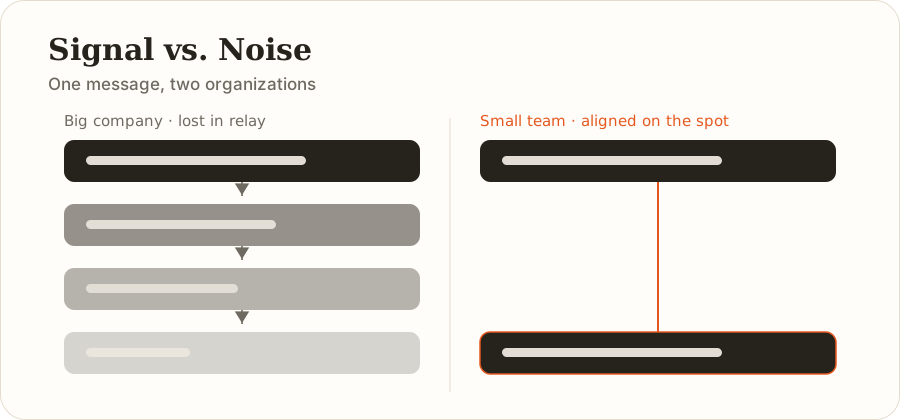
The first is low-loss transmission of context. On a small team, an idea travels from the founder to the people doing the work with almost no decay, and everyone’s understanding of the direction stays aligned. In a big company, information passes through layer after layer and is often distorted before it ever lands. What finally gets built can look very different from what was first imagined.
The second is the ability to self-correct. Once a small team spots a problem, it can change direction within days. Decisions in a large organization usually have to go through an entire, complicated process. By the time anyone truly realizes something is wrong, months have passed and the resources are already spent.
Imagine the same sentence traveling through both kinds of organization. On a small team, when the founder says “this direction is wrong” today, the team hears it right away and fixes it the same day. In a big company, the same sentence gets relayed three times — department head, project manager, execution team — and each layer adds a bit of its own interpretation. By the end, it’s no longer the sentence anyone said. (See Figure 1.)
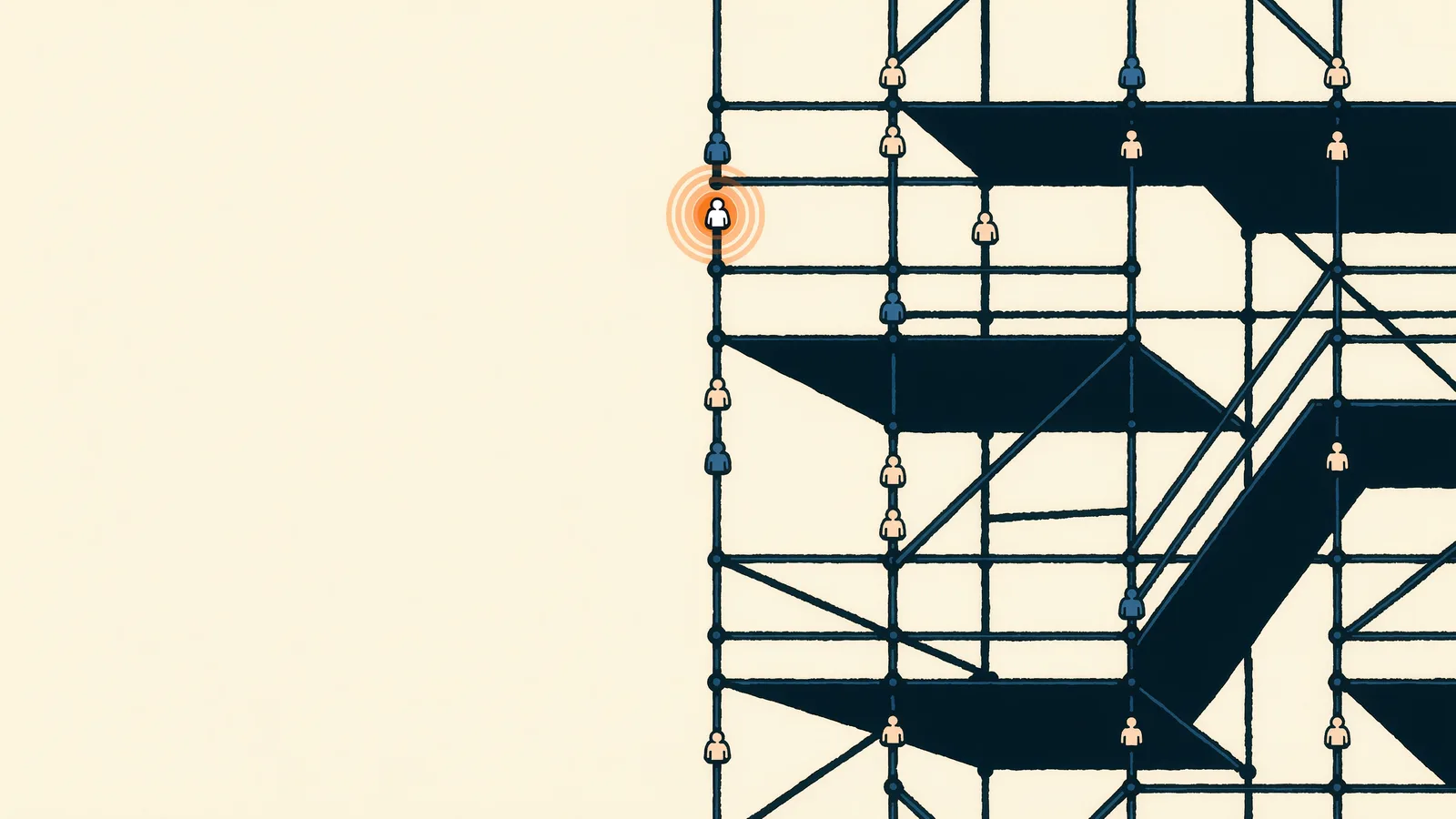
So having fewer people isn’t what makes you efficient. What you need is to build your team a good harness. The term is borrowed from the AI world, where people say an agent needs a “harness” or scaffolding around it. The team itself is that scaffolding — the structure that carries low-loss information flow. People work inside it, and in doing so, they build the same scaffolding for their agents too.
Mood Affects People — and Agents
Yubo uses an intriguing phrase: “vibe compilation.” When someone is in good shape and in a good mood, the code they write is better and comes faster. When they’re rushed, anxious, or even stifled, output usually drops noticeably.
Taken a step further, this is another kind of “vibe coding.” Not the new term for “getting AI to write code in natural language,” but something plainer: your mood compiles directly into the quality of your code.
The AI era amplifies this. Anyone can now work with several agents at once. But if you yourself are anxious and worn out, and your time with your agents feels more like “supervising” than working together, their output suffers too.
Small teams find it easier to build a relaxed, absorbed atmosphere — people are doing something together that they believe in, not finishing tasks under pressure. In big companies, internal horse races, KPIs, and competition between teams often make that atmosphere very hard to create.
Compute Power Comes From AI, Mind Power From People
One word came up again and again when Yubo talked: 心力 — roughly, drive, or mind power.
It isn’t simply how hard you work. It’s something deeper — a light in your eyes, a genuine belief in what you’re doing, a real wish from inside to see it through.
Leading a team at a big company relies more on mechanisms, processes, and goal-setting. At a startup, a small team runs more on each person believing in the direction. He even says bluntly that if you join a startup and treat it as just another job, without really believing in what it’s doing, that’s a waste — for you and for the team.
Someone asked Yubo which is more dependable, mechanisms or drive. His answer: mechanisms guarantee the floor, but they can’t hold up the ceiling. A team that runs purely on process won’t make big mistakes, but it rarely surprises anyone either. The people who take something all the way to excellence have always been the few with that light in their eyes.
Why does low-loss transmission matter? Because when the direction doesn’t get distorted, the team doesn’t have to redo work. Why does atmosphere matter? Because it decides whether each person (and each agent) can deliver at their real level. Why does drive matter? Because mechanisms can govern a process, but they can’t govern whether a person cares enough to get it right. Stack the three together, and that is the real productivity formula of a small team.
GPA: A Clear Goal, Democratic Priorities, Autonomous Execution
Getting the direction right is one thing; someone still has to make it real. Yubo sums up a management model he has practiced for half a year, called GPA.
Think of a team as a band.
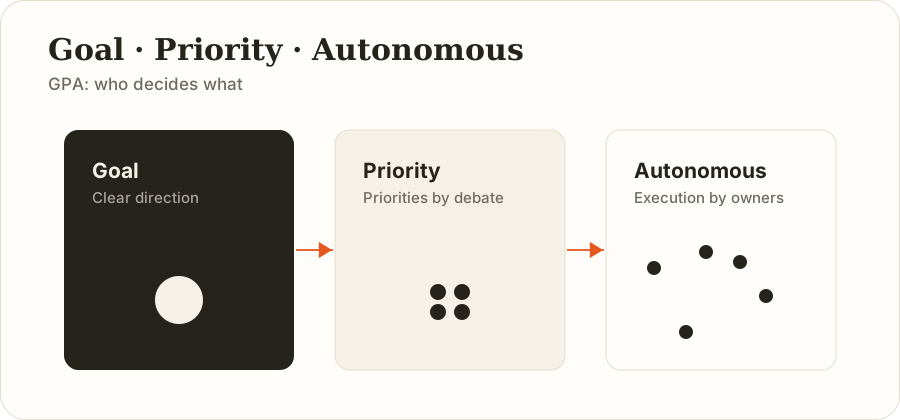
G stands for Goal. The goal has to be clear — this is the most basic layer. It’s like a conductor setting a clear key and tempo before the band starts; without that reference, every section falls apart the moment it plays. Once the direction is clear, it shouldn’t keep swinging back and forth.
P stands for Priority. Priorities are set through “centralized democracy”: the core members discuss together and agree on the few things that matter most right now — like the players in each section working out the order of the arrangement.
A stands for Autonomous. Execution emphasizes a high degree of autonomy. Team members propose solutions from the bottom up and decide how exactly things get done — each player, in their own section, decides how to play and handle the details, and the conductor doesn’t need to step in on everything.
At its core, the method draws a clear division of labor between direction, focus, and execution, which cuts the losses in decision-making. The team stays out of chaos while keeping up a fast pace of iteration. (See Figure 2.)
Why must the goal be clear? Because direction is the foundation of all collaboration on a team. If the foundation is shaky, there’s no point debating priorities or handing over execution. Why should priorities be democratic? Because each core member holds different information, and only discussing it together aligns the team on what truly matters most. Why should execution be autonomous? Because the people on the front line know better than anyone in a meeting room how the work should actually be done. These three things govern three entirely different layers. Handling them all with the same logic is the real reason most teams are inefficient.
1 Person + N Agents = A Miniature Army
With AI in the mix, the shape of organizations is changing.
Yubo proposes an interesting concept: OPT, or One Person Team. Every person can use AI tools and agents to form a small team of their own. He even imagines giving each agent a “salary” — its token cost — so agents take part in the work like real employees, and can even “graduate from intern to full-time.”
On his current team, each person has 3 to 5 agents on average, and roughly 5 to 6 of those agents deliver reliably. In other words, a 24-person team has the productive capacity of close to 50 people or more, without a noticeable rise in labor costs.
This isn’t “replacing people with AI.” It’s every person holding a miniature army they can deploy at any moment. Twenty-four people with the output of nearly fifty or more — that’s math no earlier form of organization could make work.
Talking to AI Shows You Your Own Thinking; Talking to People Gives You New Ideas
On the relationship between people and AI, Yubo also offers a very clear-headed view.
Talking with AI is, at heart, more like talking with yourself. It can help you see your own biases, organize your thoughts, and iterate again and again — but that interaction mostly turns inward.
Talking with other people turns outward. It’s collision and inspiration, the process that produces new ideas and new sparks. That part is still very hard for AI to replace.
He gives a specific warning: don’t shut yourself into an environment where AI is the only one you talk to. Going a long time without real human contact skews how you see things — and that’s something to guard against even more in the AI era.
Quick takeaways
- Efficiency isn’t built by stacking tools. First check whether information is getting distorted, whether the atmosphere is right, and whether people actually believe in the work
- GPA: a clear Goal (this is the foundation), Priorities set democratically, Autonomous execution — and none of the three should overstep into the others
- Manage each agent as a digital employee you “pay,” not a tool you grab and toss aside
- Don’t lock yourself in a room where AI is the only one you talk to — real inspiration still comes from colliding with people
Final Thoughts
In the AI era, a team’s size and its productivity have come apart. That is exactly the opportunity for small teams: you don’t have to get bigger before you get stronger.
This case holds three words you can take with you. Harness Team: a team’s first job is to build scaffolding for low-loss information flow, with people inside it and agents inside it too. Vibe Coding: atmosphere was never a soft thing — it compiles directly into the quality of the output. GPA: a clear goal, democratic priorities, autonomous execution — three things, three kinds of logic, and none overstepping the others.
Traditional management is about mechanisms, processes, and division of labor. This playbook is about belief and the ability to build together — big companies hold the floor with systems, small teams break through the ceiling with drive. AI can give everyone a miniature army. But whether the battle is won still comes down to one thing: whether the person leading the troops has that light in their own eyes.