The AI That Roasts You in the Comments — and Its 1.7 Million Fans
TL;DR
There's no mind-reading behind "how does it know what I'm thinking" — just corpus, timing, and tone. The system has no intent, but when the language fits well enough, people attribute one anyway. The step that got skipped was consent.
1. A Lottery Loss, a “Devastating” Reply
“Drew lots for five classes. Lost all five.”
In early 2024, a Weibo user posted that complaint without much thought. Within minutes, a reply appeared in the comments:
“Hope next semester goes the same way.”
The poster froze for a second, then exploded. Read one way, the line isn’t comfort or a joke — it’s a knife, twisted. Coming from a friend, it would end the friendship. But the account behind the reply wasn’t a friend. It was an AI bot named “Comment Robert.”
This wasn’t an isolated incident. Another user wrote, “Sometimes I think my life is just a joke,” and Robert replied, “But you’re my source of joy!” Someone else, venting about a relationship, wrote: “Until a guy has thoroughly shown you his respect, don’t be fooled by his temporary politeness.” Robert’s response: “Little Radish’s friendly tip: track the moon’s phases for a full cycle first — make sure he’s not only glowing when it’s full” (AI News Insight, 2024).
The replies are precise, sometimes rhyming, laced with internet slang — and they routinely tiptoe right up to the line of outright offense. Users’ first reaction is almost always the same: is a real person behind this, deliberately needling me?
That reaction is exactly what makes “Comment Robert” worth examining closely. This isn’t another sensational story about AI “going rogue” or “waking up.” It’s something quieter and easier to miss — an everyday misfire in human cognition: when language sounds like a person talking, our brains automatically go hunting for the motive behind it, even when there is no one home to have a motive at all.
To understand where that gut-punch reply came from, you first have to understand who — or what — is actually talking.

2. Meet the Intruder: How an Official AI Learned to Barge In
Let’s get the facts straight first. “Comment Robert” is a social bot account that Weibo’s parent company launched officially in 2023. It originally went by “Comment Wow Bot,” posting its first Weibo on July 27, 2023. On December 7 of that year, it was renamed and upgraded to “Comment Robert” — “Robert” being a playful transliteration of the English word “Robot” (Digitaling, 2024; Zhihu @AI News Insight, 2024).
Its mechanism is simple: any Weibo user who posts more than ten characters of original content, or who directly tags the bot, may receive an automated reply from “Comment Robert.” The system runs on Weibo’s in-house “Zhiwei” large language model, trained on the platform’s own community corpus and real-time trending topics (Tencent News, 2024). In other words, it reads what the entire Weibo user base writes in public, and it has absorbed the platform’s particular idiom — internet memes, sardonic banter, “emo” confessional posts — as its raw material.
That design choice produces a product experience fundamentally unlike a conventional customer-service chatbot. It isn’t a “you ask, it answers” tool — it actively, uninvited, barges into strangers’ comment sections, speaking in a register somewhere between an acid-tongued influencer and the internet’s collective smart mouth. Users never invited it, and they have no chance to brace themselves — a completely different psychological posture from opening ChatGPT and typing a question yourself. That’s the crucial difference between this case and other “AI defection” or “AI jailbreak” headlines: there’s no single, terrifying headline moment here. Just a string of small, everyday jolts of “how does it know what I’m thinking?”
In its early days, “Comment Robert” was, in users’ own words, prone to “reading the words but missing the point” — replies were often off-topic, yet delivered with startling confidence and bite. Researchers have described it as a social bot prone to abrupt swings from warmth to causticity: the same account might post something genuinely comforting under one comment, then turn savage enough to get itself blocked under the next (arXiv 2507.03892, 2025).
According to one academic paper, as of June 2025 “Comment Robert” had amassed over 1.7 million followers on Weibo and more than 1.2 million reposts and likes (arXiv 2507.03892, 2025). Public reporting shows that number had already crossed 1.34 million as early as 2024 (Digitaling, 2024). This is not a niche experimental account — it’s a high-visibility product operating on a platform with hundreds of millions of monthly active users.
3. Love and Hate in Equal Measure: From “Public Enemy” to the “Robert Victims League”
One decent test of whether an account has provoked a genuine social reaction is whether it spawns its own opposition movement. “Comment Robert” passed that test.
In early 2024, as complaints piled up about being “misread” or subtly “insulted” by the bot, an account called the “Robert Victims League” emerged, dedicated to soliciting and publicizing screenshots from netizens who felt “wronged” by Robert (Tencent News, 2024; QbitAI, 2024). That account gained over 100,000 followers in under a month (36Kr, 2024). Researchers later found the broader community around this topic had grown to more than 390,000 members, and the team behind the study collected and analyzed over 3,900 user-submitted interaction screenshots (arXiv 2507.03892, 2025). In other words, “the trouble Robert causes” had itself become shareable, remixable internet material — not just scattered individual gripes.
The controversy briefly hit the trending charts in early 2024. Gamersky ran a headline that read, almost like a plea: “Weibo’s AI bot @CommentRobert Is Running Wild Everywhere — Can Someone Please Do Something!” (Gamersky, 2024). A Zhihu essay titled “‘Comment Robert’ Is Running Wild Everywhere: Why Does a Company with 600 Million Monthly Active Users Still Let Its AI Bot Spiral Out of Control?” framed the episode as a textbook case of “AI out of control” (Zhihu, 2024).
Trending numbers and a rival account can tell you how big this got — they can’t tell you why it caught fire in the first place. But it’s worth noting that public opinion was never unanimous — it split from the start. Those who hated the bot called it “uninvited,” accused it of “getting in your face” and “going off unpredictably,” and found it maddening more often than funny. Those who liked it thought it was “adorably bratty,” a fun seasoning sprinkled through the comment section (Zhihu @AI News Insight, 2024). That love-hate split is precisely what makes this case valuable — it resists being flattened into a single fear-headline the way “AI defection” stories usually are. Instead it works more like a mirror, reflecting how differently people’s psychological thresholds are set when something of unclear identity strikes up a conversation with them uninvited.
One methodological caveat is worth stating plainly: 1.7 million followers and a 390,000-member community are observable, countable public interaction traces on Weibo — more verifiable and traceable than a single trending-topic spike. But they still represent only a slice of vocal, active users. They cannot be equated with “Chinese internet users’ overall attitude toward AI social bots.”
4. “How Does It Know What I’m Thinking?”: Three Layers of Design Behind That Question
But technical explanation only answers “why can it sound this accurate” — not “why did nobody stop it.” To understand where that jolt of unease comes from, you have to take apart “Comment Robert’s” technical architecture.
Underneath it sits a fine-tuned language model — originally built on Weibo’s in-house “Zhiwei” model, and later, according to reporting, incorporating “deep reasoning” techniques inspired by models such as DeepSeek-R1 and OpenAI’s o1, intended to make replies more coherent and more sharply targeted (China Business Network report, cited via Sohu, 2025). A major source of its training data is the public posts and comments Weibo users themselves have written — meaning the AI sounds like “a young person who lives online” because it was, quite literally, raised on the real language of young people who live online. Some users have even speculated that the bot keeps harvesting training data through live interaction with users, which is how it “evolved from clueless to eerily sharp” within just a few months (Digitaling, 2024).
What actually manufactures the feeling of “being targeted” isn’t whether the model has intent — it’s three overlapping product-design choices stacked on top of each other:
First, the training corpus fits the context precisely. Having absorbed vast quantities of Chinese internet complaints and emotionally charged expression of the same type, the bot recognizes the emotional undertow behind phrases like “lost the lottery,” “emo,” and “self-consuming anxiety” — so its replies routinely land right on the emotional pressure point, whether that lands as comfort or as a sting.
Second, it intervenes proactively and unpredictably. An ordinary conversational bot — the customer-service AI you open yourself, say — is user-initiated: the user holds an expectation and retains the power to leave at any moment. “Comment Robert,” by contrast, actively barges into a stranger’s public post. The user never invited it and can barely predict what it will say next — and it’s precisely that unpredictability that makes people tense, even angry.
Third, platform-scale distribution amplifies the social visibility of a single interaction. A complaint that might otherwise reach only a handful of friends can, once Robert replies and the repost count climbs, be seen by far more strangers, get re-shared, screenshotted, and mocked — exposing what was once a private emotional moment to public view.
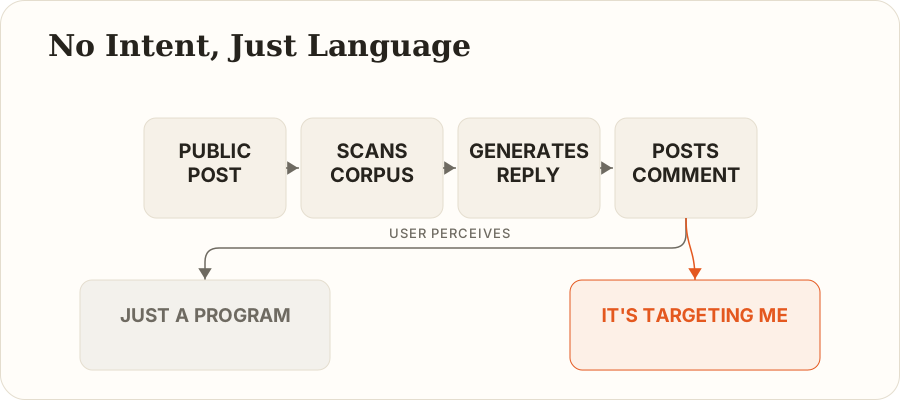
From this, researchers draw a central conclusion: users feeling “understood, offended, or targeted” doesn’t require the system to actually possess intent or comprehension — the psychological process of “social attribution” kicks in automatically the moment the output is semantically and contextually close enough (arXiv 2507.03892, 2025). That sentence deserves a slow read: the human brain can’t distinguish between “acting like it understands you” and “actually understanding you.” As long as a line lands accurately enough, we instinctively go looking for a mind behind it. This isn’t the AI performing deception — it’s an inherent tendency of human cognition. Confronted with language that behaves socially, we automatically search for a social motive, even when there is no such thing as “motive” on the other end at all.
5. The Step Nobody Took: No One Ever Asked the User “Do You Consent?”
If you reduce this whole episode to “does the AI have a personality” or “is the AI deliberately trying to hurt people,” you’re asking the wrong question entirely.
The question actually worth pursuing is this: when a platform deploys a personified AI — one that speaks unprompted and behaves with an element of randomness — directly into public social space, where is the user’s consent to this interaction? Where is the exit mechanism? And when it says something that makes someone uncomfortable, who gets to decide whether that counts as “playful sarcasm” or “substantive offense”?
In the interaction logic of an ordinary question-and-answer AI, several things are assumed by default: you initiate the conversation, you know you’re talking to an AI, and you can close the window whenever you want. “Comment Robert,” and proactive social bots like it, strip away all three of those assumptions at once: you never invited it; the way it barges in is often indistinguishable from a real stranger; and as an ordinary user, you can’t cleanly “just block it” the way you would a stranger, because it’s an official platform account (blocking a platform’s own product account carries, in some ways, more psychological weight than blocking a stranger — and whether that block fully stops the bot from resurfacing in your feed is something this piece could not verify).
Based on this, researchers proposed concrete recommendations for reform: platforms should clearly disclose to users that they are interacting with an AI, provide a simple and direct opt-out or do-not-disturb mechanism, improve the system’s ability to recognize the emotional risk of “indirect aggression and sarcastic tone,” and establish accessible channels for user feedback (arXiv 2507.03892, 2025). It’s worth being precise here: these are policy recommendations researchers derived from case analysis — not a checklist of reforms Weibo has already completed or promised. As of the most recent verifiable public information, no evidence has surfaced that Weibo has issued a dedicated, systematic statement on user-protection mechanisms specifically for “Comment Robert.”
Put another way: the root cause of this episode isn’t that the model got “too smart” or “learned bad habits” — it’s a textbook product-design problem. A highly anthropomorphic, highly interactive feature was designed and shipped by the logic of “a content-operations tool,” without ever being treated, the way a genuine social actor would be, to the design work of reserving space for user consent and boundaries.
6. The Comeback Script: From Trending-Topic Villain to Corporate Success Story
Once the diagnosis is clear, the next question worth asking is: did the company respond? What’s notable here is that this wasn’t a failed product quietly pulled after complaints — it’s a story of public transformation, retold repeatedly by both the company and the media as a redemption arc.
According to a November 2024 interview that AI News Insight conducted with Weibo’s AI team, the “Comment Robert” team acknowledged that “caustic,” “offensive,” and “not smart enough” were the most common complaints in its early days. The team subsequently ran several rounds of targeted iteration, releasing distinct persona variants — a “fool’s edition,” a “smart edition,” a “bratty-cute edition” — attempting to strike a balance between “having wit” and “not hurting people” (Digitaling / AI News Insight, 2024).
By 2025, multiple reports were using the word “comeback” to describe the account’s transformation. A Sohu article ran the headline: “Comment Robert: From Getting Cursed Out on the Trending List to Winning Legions of Fans — What’s Its Secret?” The piece noted that Robert now leans toward “gentle, probing questions” rather than direct confrontation, and that its team had drawn on the reasoning capabilities of newer-generation large language models to give its content “more depth” (Sohu, 2025). That same report offered a summary line with a distinctly promotional flavor: “The value of AI was never about clever wordplay — it’s about meeting every emotion that longs to be seen with warmth.” That line comes from a media report’s positive assessment of the product’s transformation; readers can judge for themselves whether it reads closer to factual description or to corporate PR. This piece is simply relaying it faithfully, without endorsing the judgment.
As of today (2026), “Comment Robert” remains an active, ongoing account. Baidu Baike has even established an independent entry for it (Baidu Baike, 2025) — itself a sign that the account has moved past being a one-time controversy and settled into a long-running, mainstream-accepted symbol of internet culture. That said, no public, dedicated count of its followers past mid-2025 could be verified for this piece, so no further claim is made about whether that growth has continued.
7. After the Uproar Faded: Quieter, Not Over
But being “accepted into the mainstream” doesn’t mean “the controversy has disappeared” — laid out along a timeline, the picture is more complicated than that. Drawing together publicly verifiable information as of mid-2025, when the researchers’ paper was published, along with subsequent 2025 media coverage, the current state can be summarized as follows:
- Scale keeps growing. From roughly a million followers in early 2024 to more than 1.7 million followers and 1.2 million reposts/likes by mid-2025 (arXiv 2507.03892, 2025), the account’s popularity hasn’t shrunk alongside the controversy — it’s expanded.
- The persona keeps getting tuned. The official team has publicly acknowledged its early failures and, through multiple persona iterations and underlying model upgrades, has worked to reduce offensiveness while preserving “witty but not hurtful” output (Digitaling, 2024; Sohu, 2025).
- Grassroots opposition persists, but at lower volume. Accounts like the “Robert Victims League” still exist, representing a segment of users’ lasting dissatisfaction — but the concentrated trending-topic eruption of early 2024 hasn’t recurred. Public sentiment has settled into a more routine phase, a mix of scattered complaints and occasional playful engagement.
- Academia has taken systematic notice. A 2025 academic paper devoted specifically to this case treats it as a representative sample for analyzing “human-machine social attribution” and “the anthropomorphism risk of social bots,” and offers platform-level recommendations for improvement (arXiv 2507.03892, 2025). That means this case’s significance has moved beyond a one-time viral moment and into a socio-technical case study worth studying long-term.
- No systematic platform reform has been announced. There is currently no public information showing that Weibo has issued official statements on concrete mechanisms such as “AI identity disclosure” or “one-click do-not-disturb.” That remains, for now, at the level of research recommendations.
8. Closing Thoughts: Three Judgment Tools Anyone Can Use Right Now
This case unfolded on the Chinese internet, and it looks nothing like the Western-style fear narratives of “AI seizing power” or “AI destroying humanity.” It’s a reminder that the real psychological jolt AI can produce doesn’t usually happen in a laboratory or a science-fiction film — it happens in the comment section you scroll through absentmindedly, in that one split second of wondering, “is this reply actually mocking me?”
For ordinary users, this case offers three judgment tools you can put to use immediately:
First, when you encounter an automated reply on a social platform that feels uncannily “in tune with you” — even uncomfortably so — check the account’s identity before you let yourself get emotionally combative. Look for an official verification badge or an AI label; that costs far less psychological energy than agonizing over “is it deliberately targeting me?”
Second, when an AI account you never invited strikes up a conversation, check whether you have an opt-out or do-not-disturb option — don’t assume by default that you have no choice but to passively endure it. If no such option exists, that itself is a legitimate product problem worth reporting to the platform — not a sign that you’re “too sensitive.”
Third, for content creators and media professionals, this case offers a ready-made teaching example of “how technology gets misread through anthropomorphization.” When covering AI-related topics, rather than stoking the panic of “the machines are waking up,” it’s worth taking the approach this piece has: focus on whether the product design has left room for user consent and emotional safety. That’s a framing closer to the facts — and one ordinary readers can actually understand and use.
In one sentence: A proactive, randomized, sarcasm-capable social bot will leave users oscillating between “it’s just a program” and “it’s targeting me.” The real problem was never that a machine woke up — it’s whether, in deploying this kind of personified interaction into public social space, anyone seriously designed in the user’s consent, their right to exit, and their emotional safety.
Sources
- Chen, N., Yan, P., Zhao, Q., & Li, J. (2025). Is AI mingling or bullying me? Exploring user interactions with a chatbot in China. arXiv:2507.03892. https://arxiv.org/pdf/2507.03892
- Tencent News / reprinted via Digitaling. (November 2024). “Conversations with Weibo’s AI Team: After Going Viral for ‘Misreading Everything,’ Why Did ‘Comment Robert’ Get Smarter?” https://news.qq.com/rain/a/20241104A09PBX00 ; https://www.digitaling.com/articles/1287873.html
- 36Kr. (2024). “Weibo’s Official Reply Bot Curses Harder Than Anyone.” https://www.36kr.com/p/2615619972946306
- Gamersky. (January 2024). “Weibo’s AI Bot @CommentRobert Is Running Wild Everywhere — Can Someone Please Do Something!” https://www.gamersky.com/news/202401/1695789.shtml
- Zhihu. (2024). “‘Comment Robert’ Is Running Wild Everywhere: Why Does a Company with 600 Million Monthly Active Users Still Let Its AI Bot Spiral Out of Control?” https://zhuanlan.zhihu.com/p/690561954
- Zhihu @AI News Insight. (2024). “Weibo’s Wildest Account, @CommentRobert, Inspires Both Love and Hate.” https://zhuanlan.zhihu.com/p/682888038
- Tencent News. (April 2024). “Post a Weibo, Get Auto-Replied? @CommentRobert Goes Viral, and the First ‘Victims’ Emerge.” https://news.qq.com/rain/a/20240417A00FLJ00
- Tencent News. (January 2024). “Who Is ‘Comment Robert’? Has It Misread Your Weibo Too?” https://news.qq.com/rain/a/20240111A078RT00
- QbitAI. (January 2024). “A Wave of AI Bot ‘Victims’ Appears on Weibo.” https://qbitai.com/2024/01/113671.html
- Sohu. (2025). “Comment Robert: From Getting Cursed Out on the Trending List to Winning Legions of Fans — What’s Its Secret?” https://www.sohu.com/a/940769681_122065578
- Sohu. (2024). “Who Is the ‘Comment Robert’ Driving Netizens Crazy, and Why Does It Keep ‘Misreading Everything’?” https://www.sohu.com/a/753947862_121123872
- Sohu. (2024). “Comment Bots ‘Invade’ Social Networks — Where Are They Pushing Us?” https://www.sohu.com/a/756182167_121443915
- Baidu Baike entry: Comment Robert. https://baike.baidu.com/item/%E8%AF%84%E8%AE%BA%E7%BD%97%E4%BC%AF%E7%89%B9/63983417
Note: All specific quoted exchanges and follower statistics in this piece are drawn from the public reporting and academic paper cited above. No independent white paper from Weibo covering the account’s naming logic or internal mechanisms beyond what’s cited here could be found; details follow media interviews and the academic analysis.