
The One-in-Four Number That Ate the Headlines
TL;DR
The 25% figure measures jobs exposed to generative AI; only 3.3% sit in the high-automation-potential band. Most exposure leads to redesign, not disappearance — a sentence that simply travels worse than panic.
I. One Press Conference, Two Versions of the World
On May 20, 2025, in Geneva, the International Labour Organization (ILO) — the United Nations agency responsible for employment and labor issues — and Poland’s National Research Institute (NASK) jointly published a report with a long, careful title: Generative AI and Jobs: A Refined Global Index of Occupational Exposure.
The headline number was this: roughly a quarter of the world’s jobs — about 25 percent — are exposed, to some degree, to generative AI (GenAI, the kind of technology behind ChatGPT and other systems that can produce text, images, and code). In high-income countries, that figure rises to 34 percent. But the share of the global workforce sitting in the truly dangerous zone — “high automation potential” — was only 3.3 percent, and that 3.3 percent carried a stark gender gap: 4.7 percent of women workers worldwide sit in that highest-risk category, versus 2.4 percent of men — a gap that widens further in high-income countries (9.6 percent versus 3.5 percent).
The report’s own conclusions were notably restrained: most jobs are made up of many tasks, and AI typically can only take over some of them, so “transformation” is far more likely than “replacement.” The ILO’s own press release led with exactly that framing: Generative AI Likely to Augment Rather Than Destroy Jobs.
That sentence lost.
Within days, headlines elsewhere had mutated into “Half of All Jobs Will Disappear” and “AI Will Replace a Quarter of Workers.” Some coverage went further, translating “exposure” — a statistical term describing how many tasks within a job could theoretically be handled by AI — directly into “at risk of being taken.” A technical measurement had been compressed into a chilling verdict.
What happened in between, why it happened, and where things stand now — that is the story this piece sets out to tell.

II. “Everyone Else Is About to Lose Their Job”: A Line Built to Hit a Nerve
Speed alone doesn’t explain how thoroughly this misreading has traveled. It also landed at exactly the right — or wrong — moment. Had this report appeared in 2019, it might have stayed a niche academic debate. Instead it arrived in 2025 and 2026, at a moment when the ground was already unusually raw.
Start with the numbers. According to the outplacement firm Challenger, Gray & Christmas, U.S. companies announced more than 1.2 million layoffs in 2025 — the highest total since the pandemic year of 2020. In the first seven months of 2026 alone, the tech sector shed more than 200,000 jobs, already surpassing the roughly 124,000 tech layoffs recorded in all of 2025. The number of layoffs in which employers cited “AI” as a reason climbed from about 55,000 in 2025 to nearly 88,000 by the middle of 2026, per Challenger’s tracking.
Then look at who’s been doing the talking. Anthropic CEO Dario Amodei, in a widely quoted 2025 interview with Axios, warned that AI could wipe out half of entry-level white-collar jobs within five years and push U.S. unemployment to somewhere between 10 and 20 percent. Ford CEO Jim Farley has said something similar. These are not outside analysts speculating from a distance — they are the people building the technology, telling the public what they claim is coming.
Now look at who is absorbing the anxiety. A 2025 global Ipsos survey (the AI Monitor) found a telling split: only 31 percent of respondents believed AI would improve their national job market, versus 35 percent who expected it to get worse — broad pessimism about the macro picture. But asked about their own jobs specifically, 38 percent expected things to improve, compared to just 16 percent who expected them to worsen. In other words, most people simultaneously believe “AI is working out fine for me” and “this thing is destroying everyone else’s livelihood.” That contradiction is precisely why headlines like “a quarter of jobs will disappear” land so effectively — they aren’t addressed to “you.” They’re addressed to “everyone,” and everyone includes the person updating their résumé, the student weighing graduate school, the employee quietly wondering whether to jump ship.
For Chinese readers, that same anxiety has taken on a local shape. During the 2026 campus recruiting season, multiple industry reports — including Liepin’s 2025 Talent Supply and Demand Trend Report — noted that “AI proficiency” has shifted from a résumé bonus to a baseline requirement, while hiring for traditionally “easy to replace” roles — entry-level copywriting, customer service, basic data entry — has fallen faster than the average, even as demand for AI-adjacent roles such as algorithm engineers, data annotators, and AI product managers grows quickly. The same technological shift, in other words, is producing a strikingly similar pattern among China’s new graduates as the one the ILO documented globally: not every job disappearing at once, but a reshuffling within the labor market itself.
III. The Two Words That Got Swapped: Exposure and Displacement
Whether it’s a tech executive’s grim prophecy or a new graduate’s job-hunting anxiety, both trace back to the same root question: what did the report actually say? Understanding this communications accident requires untangling two words that are often, wrongly, treated as synonyms.
Exposure describes what share of the specific tasks within an occupation could, in theory, be handled or assisted by current generative AI technology. It is a measure of technical potential — whether AI can do something — not whether AI will be used to do it, and certainly not whether the person doing that job today will lose it as a result.
Displacement describes an actual, realized decline in jobs or labor demand due to automation — people genuinely out of work, or positions genuinely eliminated.
The ILO/NASK report measured the former. Methodologically, researchers used large language models to analyze the task lists that make up thousands of specific occupations in the International Standard Classification of Occupations (ISCO), judging the technical feasibility of GenAI handling each task, then aggregating those judgments into a weighted “occupational exposure index.” The approach builds on earlier work by OpenAI, the University of Pennsylvania, and others; the ILO team’s contribution was extending it across more countries and finer occupational categories.
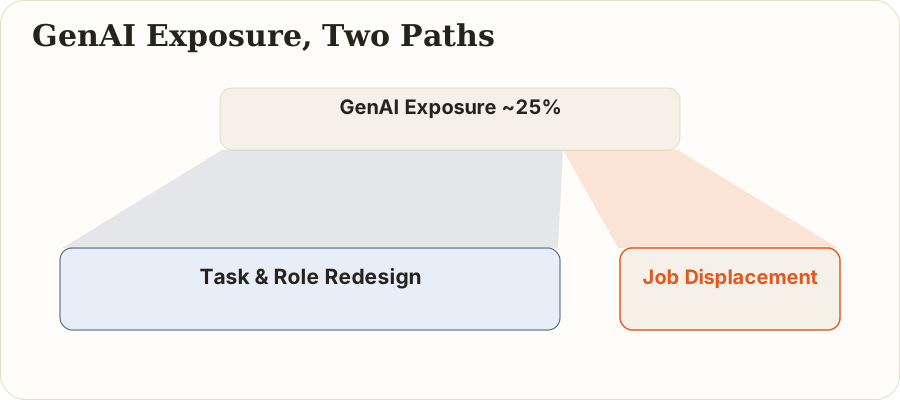
And this is exactly where the trouble starts: a job being “exposed” can map onto at least four entirely different real-world outcomes —
- Part of the job’s tasks get taken over by AI — the person shifts from “typist” to “reviewer of AI output.” The job survives, but its content changes.
- A company uses AI to boost productivity — the same number of employees produce more, and headcount stays flat or even grows as the business expands.
- A company trims some staff while keeping its core team — headcount declines modestly.
- The job is eliminated outright.
The ILO report itself repeatedly stresses that scenario four is the least likely outcome, while scenarios one and two are the norm. But “25 percent of jobs are exposed to some degree” was simplified at every step of its journey through the media, until it became “25 percent of people will lose their jobs” — a textbook case of technical potential being swapped for a foregone conclusion.
Here’s an analogy simple enough for a high schooler: saying “this math problem could, in theory, be solved with a calculator” is not the same as saying “students no longer need to solve it.” Whether the calculator actually replaces the act of doing the problem depends on whether the teacher allows it, how hard the problem is, and how the exam is designed. The relationship between occupational exposure and displacement follows the same logic: what’s technically possible and what an organization decides to do are two entirely different things.
IV. Four Parties, Four Different Stories
The conceptual sleight of hand was only the starting point. What really let “25 percent” snowball is that every party involved found something in it worth repeating for their own reasons. It’s worth laying the key players’ positions side by side.
The ILO/NASK research team has been the most conservative voice throughout. The report’s authors have repeatedly clarified that most occupations consist of multiple tasks requiring human involvement, and that “transformation is more likely than replacement.” In high-income countries, roughly a third of jobs show some degree of exposure — and, crucially, women are significantly overrepresented in the “high automation potential” category, a distributional risk that total-number narratives routinely obscure. That gender figure comes from the same ILO/NASK report, not a separate analysis: worldwide, 4.7 percent of women workers sit in the occupational category with the highest automation potential, versus 2.4 percent of men — a gap that widens further in high-income countries (9.6 percent versus 3.5 percent). Reuters covered this finding in May 2025. This means that focusing solely on “how many jobs will disappear in total” misses a more specific, more urgent question: who is actually bearing the greater risk?
Tech executives, by contrast, have largely been building narratives that serve their commercial decisions. Anthropic’s Amodei has made his warnings unusually forceful, arguing that “as the people building this technology, we have an obligation to be honest about what’s coming.” But there is real dissent within the industry — Cisco field CTO Andy Thurai has publicly countered that “AI providers — Anthropic, OpenAI, and various consulting firms — have to say extreme things to grab attention and manufacture FOMO.” OpenAI’s Sam Altman, meanwhile, has leaned toward a “realistic optimism” grounded in the history of previous waves of automation, a notable contrast with the pessimism of his former colleague, Amodei.
The companies doing the laying off have their own credibility problem: their stated reasons look inflated. TechCrunch has maintained a running 2026 list of companies “blaming AI” for layoffs — from Salesforce, whose CEO Marc Benioff said bluntly, “I need less heads,” cutting roughly 5,000 customer-service jobs across two rounds, to Snap, which cut about 16 percent of its staff with CEO Evan Spiegel citing AI progress as a key driver, to Monday.com, which joined the list in July 2026. But Challenger’s own data tells a more complicated story: in January 2026, jobs where AI was cited as the layoff reason accounted for only about 7 percent of total layoffs that month (7,600 out of 108,435), with contract losses, market conditions, and corporate restructuring doing far more of the driving. This has given rise to a new term — “AI washing”: repackaging layoffs that should really be attributed to pandemic-era overhiring, falling revenue, or investor pressure as “we’re becoming more efficient with AI,” because that story is friendlier to a company’s stock price and image than admitting to poor management. Even OpenAI’s Sam Altman has conceded the point: “There is definitely some AI washing happening — some companies were going to do layoffs anyway, and are just blaming AI.”
Ordinary workers — especially new graduates and people in entry-level roles — are the party with the least voice in this debate and the most direct exposure to its consequences. Klarna, the European payments company, has become a cautionary tale often cited on both sides — but the case itself carries a fact chain worth untangling first. In February 2024, CEO Sebastian Siemiatkowski and OpenAI jointly announced that Klarna’s AI customer-service system had, in its first month, handled 2.3 million conversations — “equivalent to the workload of 700 full-time agents” — with average resolution time cut from 11 minutes to under 2. That figure is the company’s own workload-equivalence calculation, not an audited layoff count, and the public record does not establish that 700 specific workers were laid off because the system went live. Klarna’s headcount did fall sharply, from 5,527 at the end of 2022 to 3,422 at the end of 2024 — a drop of nearly 40 percent — but reporting from CNBC and other outlets attributes most of that decline to a hiring freeze and attrition beginning in 2023, not a discrete layoff event tied to the chatbot’s launch. By May 2025, the same CEO was publicly admitting: “We pushed too hard for efficiency, and the result was a decline in service quality that wasn’t sustainable.” The company began expanding its human-agent hiring again, particularly for the kinds of situations AI handled poorly — complex disputes, refund disagreements, hardship claims. What this case actually demonstrates isn’t “AI laid off 700 people, and they were later rehired.” It’s that how much of a workload AI can absorb, and whether a company should translate that workload directly into headcount cuts, are two separate questions — and Klarna’s own experience is that treating the first as an automatic answer to the second turned out to be costly enough to reverse.
V. What Machines Are Good At — and What Humans Still Aren’t Replaceable For
Setting the competing agendas aside, there’s a more basic question worth returning to: can AI actually do this job, or not? Judging whether exposure will turn into displacement means first understanding where the real technical boundaries of generative AI currently sit.
Generative AI — whether a general-purpose model like ChatGPT or a specialized system built for coding or customer service — is currently best at handling formatted, templated, repeatable language and information tasks: summarizing meeting notes, drafting standardized emails, doing a first pass at sorting customer inquiries, writing repetitive code snippets, producing basic data summaries. These tasks share a common feature: the relationship between input and output is relatively fixed, and the standard for a “correct” or “acceptable” answer is fairly clear.
But AI remains broadly weak at several categories of work that depend heavily on human judgment:
- Defining the objective. Figuring out “what problem are we actually trying to solve here” often requires cross-departmental negotiation, organizational politics, and the ability to untangle vague, conflicting demands — judgment calls AI cannot make.
- Handling exceptions. In real-world business processes, a huge share of time goes into situations that fall outside the standard playbook — an incoherently furious customer, a contract that doesn’t follow any recognizable format. These are exactly the situations where AI is most likely to fail (and precisely where Klarna’s system fell short).
- Bearing real-world responsibility. Who is accountable for a bad business decision, a medical misdiagnosis, or a flawed legal document? Current institutional design still requires a human name attached to the outcome.
- Relationships and trust. Client relationships, team collaboration, and cross-system accountability depend heavily on accumulated interpersonal trust — not merely on processing information.
So whether a given job ultimately gets reshaped or eliminated is, to a large degree, not determined by an AI model’s benchmark scores alone, but by how a company chooses to redesign its workflows. Whether a business treats AI as “a tool that makes junior employees more productive” or “a justification for cutting junior employees altogether” is an organizational decision — not a technological inevitability.
That distinction is exactly what the Stanford Digital Economy Lab found when its researchers — Erik Brynjolfsson, Bharat Chandar, and Ruyu Chen — tracked millions of payroll records from the data firm ADP through June 2026. Their finding was far more granular than the headline number suggests: not every age group is losing ground in AI-exposed occupations. The “gap” here is a relative benchmark, not an unobservable “what if AI never happened” counterfactual — specifically, employment among 22-to-25-year-olds in highly AI-exposed occupations, as of June 2026, stood about 19 percent below where it would be if it had kept pace with employment among similarly aged workers in less-exposed occupations, a divergence that has widened steadily since the researchers first documented it (15 percent as of the July 2025 data). Experienced workers show no comparable gap. That 19-point gap shows up almost entirely as reduced hiring, not increased firing. Companies haven’t been mass-laying-off young employees already on staff; they’ve quietly shrunk the number of new positions they’re opening. The researchers themselves are careful to frame this as descriptive, continuously updated evidence, not causal proof: as they put it, “the data alone cannot establish how much of the divergence was caused by generative AI rather than other forces affecting the labor market.” In Brynjolfsson’s own words on the broader picture: “We do not see widespread, economy-wide job displacement associated with AI.”
This finding precisely confirms the earlier point that technical potential is not the same as a foregone conclusion. AI is genuinely reshaping the structure of the labor market — but not through mass layoffs. It’s doing it by narrowing the entry point. The people hit first aren’t those already holding jobs; they’re the people who haven’t gotten in the door yet.
VI. Anatomy of a Media Accident, in Three Layers
With the technical boundaries laid out, one question remains: how did a properly cautious statistical finding warp, step by step, into “a quarter of people are about to lose their jobs”? Pulling the threads together, this “25 percent unemployment” media accident breaks down into three layers of root cause.
Layer one: the statistical concept itself was built to travel poorly. “Exposure rate” is a technical term that requires context to understand correctly, while “unemployment rate” and “being replaced” are everyday phrases everyone instantly grasps and instinctively feels. When a report written for policymakers and researchers gets compressed into a headline under fifteen characters, what typically gets lost first is the crucial qualifier that “exposure does not equal displacement.” This isn’t any individual reporter’s carelessness — it’s a structural tension between precision and virality.
Layer two: most parties had an incentive to amplify the fear, and the corrective voices started at a structural disadvantage. For tech executives, saying “AI is powerful enough to eliminate half of all jobs” simultaneously reassures investors about the technology’s capabilities and offers a more dignified cover story for layoffs already decided upon than “we mismanaged the business.” For media outlets, “half of all jobs will disappear” is simply more clickable than “clerical occupations face moderate risk of task transformation.” For ordinary people, this apocalyptic framing hit an economic insecurity that was already there, which is exactly why it kept spreading. The voices actually saying “it’s more complicated than that” — the ILO report’s own qualifiers, Challenger’s data showing AI accounts for only a small share of layoffs, Cisco’s CTO calling out “FOMO marketing” — never had the same reach as the sensational aggregate number.
Layer three, and the one most easily overlooked: the aggregate narrative buried the distributional risk that actually deserves attention. While everyone was busy arguing over whether the true number is 25 percent or 50 percent, almost no one was asking: why are women overrepresented by two-to-one in the highest-automation-potential category (Reuters, 2025)? Why is the impact concentrated so heavily on 22-to-25-year-olds rather than spreading evenly across age groups (Stanford Digital Economy Lab ADP tracking data, 2025–2026)? Why, in China’s campus recruiting market, has the decline in “traditionally replaceable” positions so clearly outpaced the growth in “AI-adjacent new roles,” rather than the shift distributing evenly across fields of study? These uneven risk distributions are the part of this technological transition that policymakers and companies actually need to reckon with — and the scary-sounding but ultimately vague “25 percent of jobs will disappear” figure has crowded these far more specific, far more actionable questions out of the public conversation.
VII. A Year Later: Where the Story Stands Now
The media accident didn’t end things — the story kept moving. From May 2025 to August 2026, more than a year has passed in the debate over “25 percent,” and several threads are worth pulling out to see where things stand today.
The aggregate narrative keeps getting revised. In a follow-up study of European workplaces, the ILO added an important detail: among the Polish workers it surveyed, the share of employers “formally” introducing generative AI was actually quite limited, while informal, unofficial use by employees was far more common. At workplaces where AI had been formally deployed following negotiation with workers, both usage rates and willingness to keep using the tools were notably higher. This surfaces a variable the aggregate narrative never accounted for at all: how much AI actually “takes jobs” depends heavily on whether it’s “quietly slipped into workflows” or “formally introduced through negotiation” — a process variable that labor and management can actually influence, not a technologically predetermined outcome. That said, this is a single-country survey sample and shouldn’t be extrapolated directly to a global conclusion.
The evidence for distributional risk has only strengthened. The Stanford Digital Economy Lab’s tracking research is still being updated as of 2026 (the team maintains a live dashboard and monthly indicators called “Canaries,” a reference to canaries in coal mines as early warning signals). The revised paper the team published in August 2026 shows the employment gap for young workers hasn’t narrowed at all — it has widened from 15 percent at the July 2025 data vintage to 19 percent as of June 2026 — and the researchers repeatedly stress this remains “descriptive” evidence, not causal proof. This evidence largely confirms the direction the ILO report originally pointed to — that women, junior roles, and clerical positions bear disproportionate pressure — while sharpening the resolution considerably: it’s not every “highly exposed” job facing pressure equally, but specifically the combination of “highly exposed plus young plus entry-level” that’s bearing the brunt.
The authenticity of “AI layoffs” itself has come under systematic scrutiny. Challenger, Gray & Christmas, the firm that specifically tracks U.S. corporate layoff announcements, reports that across all of 2025, AI was cited as a layoff reason in about 4.5 percent of cases; that share has ticked up in certain months of 2026, but January 2026 saw AI cited in only about 7 percent of layoffs, with contract losses and restructuring doing most of the actual driving. Meanwhile, “AI washing” has become a widely discussed term throughout 2026 — describing companies repackaging layoffs that should be attributed to other causes as “the inevitable result of technological progress.” This means even the seemingly ironclad claim that “tech companies are laying off workers en masse because of AI” deserves a question mark: how much of it is genuine technological displacement, and how much is opportunistic marketing or financial scapegoating? No institution has yet offered a precise breakdown.
A cautionary case has emerged at the individual-company level, though it needs stating precisely. Klarna’s arc — from announcing that its AI had matched the workload of 700 agents, to admitting an efficiency-first push had hurt service quality and expanding human-agent hiring again — has become a frequently cited case. Stated precisely, though, it doesn’t establish a confirmed loop of “700 people laid off, then all rehired” — the public record doesn’t support that loop. What it does demonstrate is narrower: that there is a real, costly gap between “AI can handle this workload” and “a company should convert that into headcount cuts” — a gap closed only through actual, high-stakes business trial and error.
VIII. My Take
Having laid out this evidence and these competing positions, I want to say where I land. What follows is my judgment, not a statement of fact, and readers are free to disagree.
I believe the claim that “AI will make a quarter of people unemployed” has traveled as far as it has largely because it took a structural problem that demands specific analysis and compressed it into an aggregate number capable of triggering collective anxiety — and that simplification turns out to be “useful” to nearly everyone in the chain that spreads it. It’s useful to tech companies. It’s useful to media outlets. It even offers already-anxious readers a strange sense of confirmation — if everyone’s doomed, my own situation doesn’t look so bad by comparison. But the cost of that simplification is that the questions that actually deserve discussion get drowned out: not “will AI take jobs,” but whose entry points into the labor market are quietly narrowing, who is bearing the largest cost of this transition, and whether that cost can be distributed more fairly through policy, training, and negotiation between labor and management.
I also believe that the tech executives claiming “AI is about to eliminate half of all jobs” and the media outlets claiming “AI layoffs are just a coincidence” deserve equal skepticism — the former have an incentive to exaggerate the technology’s capabilities to boost valuations and stock prices, the latter have an incentive to compress complicated problems into clickable headlines. The signals actually worth trusting live in neither camp’s public statements — they live in third-party, verifiable, continuously updated empirical tracking, like Stanford’s ADP payroll data or the ILO’s gender- and occupation-disaggregated statistics.
IX. Four Things You Can Actually Do, If You’re Still Sending Out Résumés
After all this, it comes down to a practical question: if you’re not a policymaker or a corporate executive, what use is any of this to you? I think it comes down to four concrete, verifiable things — shifting your attention away from the unanswerable aggregate question of “will AI take jobs or not” and toward four specific, trackable indicators instead:
-
Track the net change in “new positions created” versus “positions eliminated” in your own industry — not a single executive’s quote about “using AI.” Corporate statements citing AI as a layoff reason carry their own risk of being “washed”; what actually tells you something is the raw increase or decrease in hiring data.
-
If you’re a new graduate or early in your career, watch one specific metric closely: entry-level hiring volume. The evidence so far — including Stanford’s ADP tracking — points the same direction: AI’s impact currently shows up first and most clearly as a narrowing entry point, not as layoffs of people already on staff, though this remains a descriptive, continuously updated finding rather than a settled conclusion. That means the difficulty of finding a job may be rising earlier and more quietly than layoff headlines suggest, which makes it worth planning your skills ahead of time rather than waiting for a “mass layoffs” headline to react to.
-
Pay attention to how your own company introduces AI — quietly replacing people, or negotiating with them. The ILO’s European research points to a pattern you can verify yourself: AI tools introduced through negotiation and transparent deployment see better employee acceptance and better long-term outcomes; passive, poorly communicated rollouts are far more likely to end up like Klarna’s.
-
Before reacting to any headline claiming “AI will eliminate X percent of jobs,” ask one question first: is this talking about an exposure rate, or a displacement rate? This is a test you can apply to nearly every similar story — the original research behind most sensational headlines is almost always measuring technical potential, not a guaranteed outcome. The distance between those two things is what actually determines your future and mine, and it’s also the part most easily swallowed whole by a headline.
Sources
- ILO/NASK, Generative AI and Jobs: A Refined Global Index of Occupational Exposure (2025): https://www.ilo.org/publications/generative-ai-and-jobs-refined-global-index-occupational-exposure
- ILO, Generative AI and Jobs: A 2025 Update (Research Brief PDF): https://www.ilo.org/sites/default/files/2025-05/Research%20brief_GenAI%202025%20Update.pdf
- ILO press release, “One in four jobs at risk of being transformed by GenAI”: https://www.ilo.org/resource/news/one-four-jobs-risk-being-transformed-genai-new-ilo%E2%80%93nask-global-index-shows
- ILO press release, “Generative AI likely to augment rather than destroy jobs”: https://www.ilo.org/resource/news/generative-ai-likely-augment-rather-destroy-jobs
- UN News (May 2025): https://news.un.org/en/story/2025/05/1163486
- Reuters (report on threat to women’s work, May 2025): https://www.reuters.com/business/world-at-work/ai-poses-bigger-threat-womens-work-than-mens-says-report-2025-05-20
- ILO European workplace study: https://www.ilo.org/resource/article/generative-ai-work-what-it-means-jobs-europe-and-beyond
- Ipsos AI Monitor 2025: https://resources.ipsos.com/rs/297-CXJ-795/images/Ipsos-AI-Monitor-2025.pdf
- Stanford Digital Economy Lab, “Canaries in the Coal Mine? Six Facts about the Recent Employment Effects of Artificial Intelligence”: https://digitaleconomy.stanford.edu/publication/canaries-in-the-coal-mine-six-facts-about-the-recent-employment-effects-of-artificial-intelligence/
- Stanford Digital Economy Lab follow-up update (August 2026): https://digitaleconomy.stanford.edu/news/canariesaug26/
- TIME, “Who’s Losing Jobs to AI? New Stanford Analysis Breaks It Down”: https://time.com/7312205/ai-jobs-stanford/
- The Register, “AI robs jobs from recent college grads, but isn’t hurting wages, Stanford study says”: https://www.theregister.com/2025/08/26/ai_hurts_recent_college_grads_jobs/
- Axios, “AI jobs danger: Sleepwalking into a white-collar bloodbath” (Dario Amodei interview, May 2025): https://www.axios.com/2025/05/28/ai-jobs-white-collar-unemployment-anthropic
- Forbes, “Dario Amodei Doubled Down On His AI Jobs Warning” (February 2026): https://www.forbes.com/sites/kolawolesamueladebayo/2026/02/21/dario-amodei-doubled-down-on-his-ai-jobs-warning-heres-whats-different-now/
- TechCrunch, “Monday.com is the latest tech company to blame AI for layoffs — here are 20 others” (July 2026): https://techcrunch.com/2026/07/25/the-running-list-major-tech-layoffs-in-2026-where-employers-cited-ai/
- Forbes, “AI Cost 21,000 Jobs At Oracle This Year” (June 2026): https://www.forbes.com/sites/maryroeloffs/2026/06/04/tech-industry-loses-123000-jobs-this-year-ai-is-the-most-cited-reason-for-layoffs/
- Built In, “Did AI Take Your Job? The Truth About AI Washing”: https://builtin.com/articles/ai-washing-layoffs
- CNBC, “AI-washing and the massive layoffs hitting the economy” (November 2025): https://www.cnbc.com/2025/11/04/white-collar-layoffs-ai-cost-cutting-tariffs.html
- Challenger, Gray & Christmas monthly reports (multiple issues): https://www.challengergray.com/blog/
- Bigeye, “Klarna’s AI customer service deployment | AI Autopsy”: https://www.bigeye.com/blog/klarnas-ai-customer-service-deployment
- Forbes (Quicker Better Tech), “Klarna Reverses AI Push, Says Customers Prefer Human Support” (May 2025): https://www.forbes.com/sites/quickerbettertech/2025/05/18/business-tech-news-klarna-reverses-on-ai-says-customers-like-talking-to-people/
- CNBC, “Klarna CEO says AI helped company shrink workforce by 40%” (May 2025): https://www.cnbc.com/2025/05/14/klarna-ceo-says-ai-helped-company-shrink-workforce-by-40percent.html
- Forbes (Jack Kelly), “Klarna’s AI Assistant Is Doing The Job Of 700 Workers, Company Says” (March 2024): https://www.forbes.com/sites/jackkelly/2024/03/04/klarnas-ai-assistant-is-doing-the-job-of-700-workers-company-says/
- Liepin, 2025 Talent Supply and Demand Trend Report, related coverage (Sina Finance): https://finance.sina.com.cn/tech/roll/2026-02-05/doc-inhkutyw1881081.shtml
- Sina Finance, “How AI Is Reshaping Employment — Observing Labor Market Challenges and Change Through Recruiting Data”: https://finance.sina.com.cn/wm/2026-03-31/doc-inhswttw2022651.shtml
- Shanghai Observer, “2026 Campus Recruitment White Paper Released: AI Widely Adopted in Campus Hiring”: https://www.shobserver.com/news/detail?id=1141281