A Plain-English Guide to Large Language Models
TL;DR
An LLM isn't a database of stored answers — it's an engine that computes, token by token, what is most likely to come next given the context. Its fluency, its breadth, and its hallucinations all come from that one mechanism. Understand it and you know when to trust it and when to check for yourself.
By 2026, AI is woven into daily life whether we notice it or not. You might be actively using it for research, planning your day, or just chatting with it — or you might be on the passive end, scrolling social media or shopping online, with AI quietly shaping what you see. It’s become as invisible as electricity or running water: you only notice it through its effects — on what you believe, how you feel, the decisions you make, and the consequences you alone end up owning. That’s reason enough for everyone to understand it, at least a little.
We got used to being dazzled early on — AI that seemed to know everything, answered fluently, finally passed the Turing test. And most of us have also watched it confidently make things up. Why does it swing between brilliant and wrong? Because both come from the exact same mechanism. Understanding that mechanism lets us use AI with our eyes open — getting the benefit without missing the risk.
That’s the point of this series: not to review any one product, but to look at the machinery underneath, so we can find the best way to work alongside it.
1. The “Large Language Model” Is the Engine Underneath
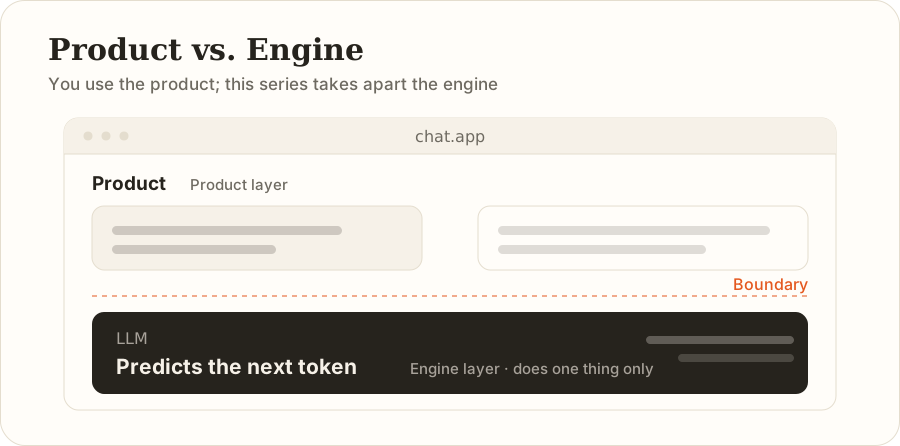
When people talk about “AI” day to day, they usually mean the chatbot products they actually use — ChatGPT, Claude, and the rest. Those products come with an interface, system instructions, conversation memory, safety policies, and tools bolted on. But the engine actually generating the text is called a Large Language Model, or LLM.
If you had to sum it up in one sentence: an LLM is a neural network that looks at the context it’s seen so far, calculates which token is most likely to come next, and generates its answer one step at a time.
The easiest way in is to think of it as “a very well-read conversationalist who’s read an enormous amount of text and is great at finishing your sentence.” You say the first half, it fills in the second half — convincingly, like a person would. The metaphor isn’t perfect, but it captures the core truth: the model is generating language first and foremost. It isn’t looking up a single correct answer in some reliable database.
Let’s walk through, step by step, how this remarkable engine actually works.
2. How Does a Single Answer Actually Get Generated?
Step One: Tokenization
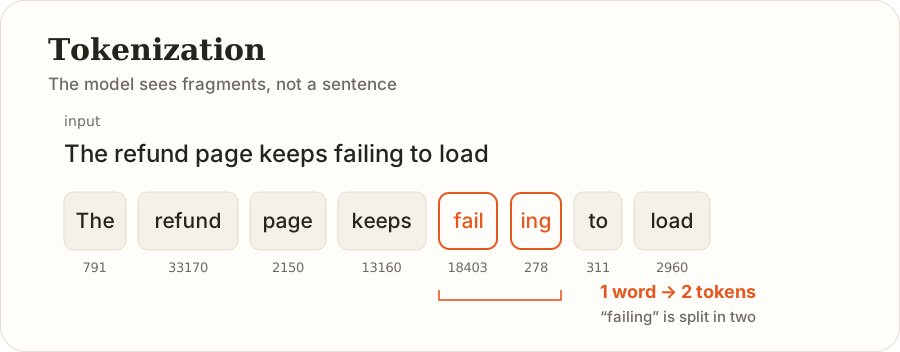
When you type something to the model, it doesn’t process your sentence as a whole — it first chops your words into small chunks called tokens. A token might be a whole word, a piece of a word, or a punctuation mark. Think of it like a jigsaw puzzle: a common word usually fits in a single piece, while a rare or unusual word — say, “antidisestablishmentarianism” — gets broken into two or three pieces. Different models slice things up slightly differently.
Why not just split by word? Because the model has to handle multiple languages, code, and symbols all at once, and one statistically-derived splitting rule turns out to be the most efficient way to do that — even if it doesn’t always match how we intuitively read a sentence.
So what the model actually “sees” isn’t a clean sentence the way you’d read it — it’s a string of token IDs. Everything that follows starts from those fragments.
Step Two: Turning Tokens into Coordinates (Embedding)
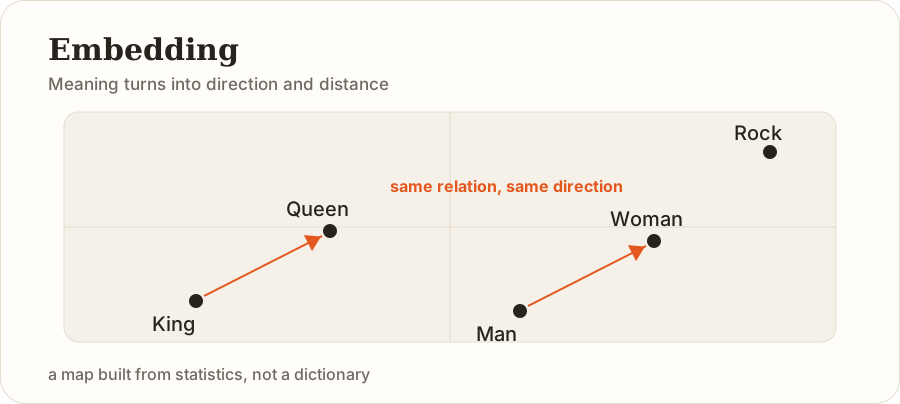
Every one of those puzzle pieces (each token ID) gets mapped to a string of numbers — a vector, more commonly called an embedding. Why numbers? Because computers only do math, not language, so there needs to be a way to represent meaning numerically — placing words with similar meanings close together, and words with different meanings far apart, so the whole thing can be handled mathematically.
You can think of a vector as the model’s internal coordinate system. After training, the coordinates for “king” and “queen” end up much closer together than the coordinates for “king” and “rock” — not because the model looked anything up in a dictionary, but because it saw those two words appear in similar sentence patterns over and over across a massive body of text, and worked out the pattern on its own. This coordinate map is a statistical map, not a dictionary: it records how words tend to co-occur, not their official definitions.
Step Three: Finding the Connections (Attention)
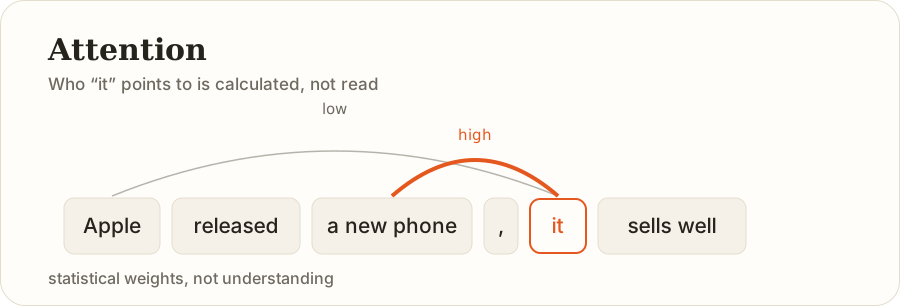
This is one of the most important steps in how a large language model handles context. It has to decide, at each position, which earlier words actually matter for what comes next. Why does this step exist at all? Because the same word can point to different things depending on the sentence.
Take: “Apple released a new phone, and it’s selling really well.” Any human reader instantly knows “it” refers to the phone, not the company. But the model has to actually run a calculation to work that out. Picture a room full of editors all reading the same sentence — each one tracking a different kind of relationship: one watches subject-object pairs, another tracks what each pronoun points back to. They tally up their individual judgments, and together that determines which direction the next word should go.
This step is what makes the model look like it understands sentence structure. But what it’s actually computing is a statistical measure of how strongly two words are correlated — you can’t leap from this mechanism straight to “the model reasons like a human.”
Step Four: Scoring the Options (Softmax)
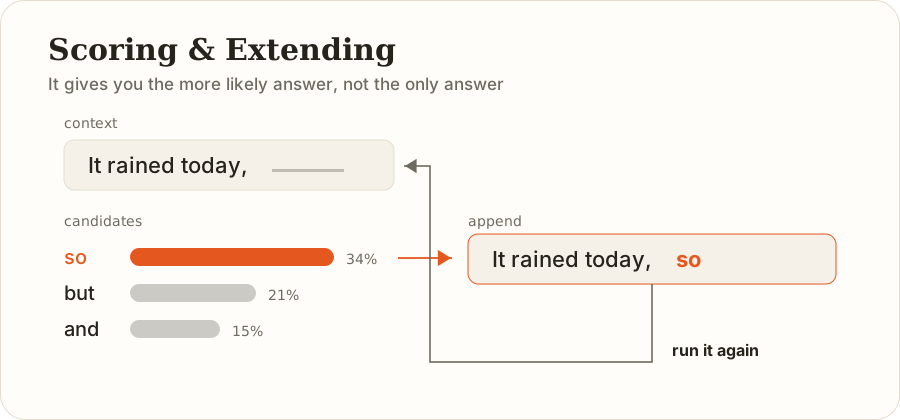
After all the previous steps, the model assigns a score to every candidate word in its vocabulary for what should come next, and converts that score into a probability. Why a score instead of one definitive answer? Because language itself isn’t deterministic — the same sentence could reasonably continue with “so,” “but,” or a specific noun. Each option is valid within the rules of language; they’re just valid to different degrees.
Think of it like a raffle drum: every candidate word has a probability tag on it. Higher-probability words get more weight and a better shot at being picked. The system can either grab the single highest-probability word, or randomly draw from among several high-probability candidates.
The upshot: what the model hands back is never the one correct answer — it’s the answer that’s most probable linguistically. And “most probable” is not the same thing as “factually correct.”
Step Five: Chaining It Together (Autoregressive Generation)
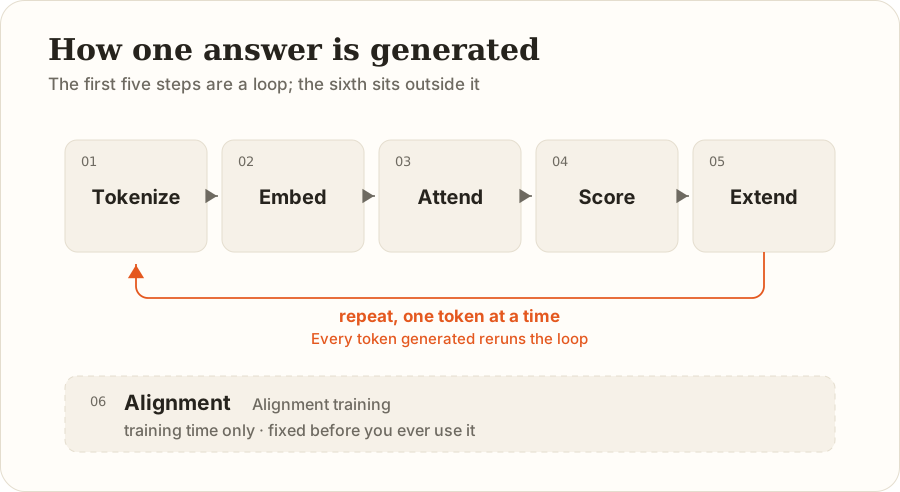
Once a token is chosen, the model appends it to the existing context and predicts the next one. This loop repeats until it hits a stop signal or an output limit.
Why generate one token at a time instead of planning out the whole answer first? Because there is no “whole answer” sitting in the model’s head — there’s only the ability to keep repeating this one move: predict the next token given everything generated so far. That also explains a familiar phenomenon: in a long answer, if it veers off in the wrong direction early on, everything that follows will keep building confidently — and convincingly — on top of that wrong turn.
So length is not a signal of reliability, and neither is “this needed a long explanation, so it must be thorough.” The longer an answer runs, the more chances it’s had to quietly drift off course somewhere early and just kept going.
Step Six: Learning to Talk (Alignment Training, RLHF)
The first five steps happen fresh every single time you ask the model something. Step six is different — it happens back during training. The training team further tunes the model so it’s more willing to follow instructions, explain its reasoning, and decline certain harmful requests. Only after this kind of alignment training is a model considered ready to be shipped inside a chatbot product like ChatGPT or Claude.
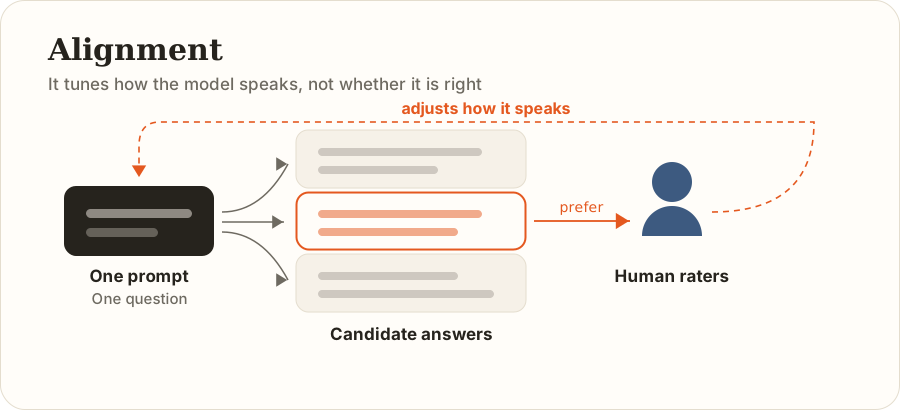
The training team recruits large numbers of human raters, has the model generate multiple answers to the same question, and has raters judge which answer better fits what’s wanted. That feedback tells the model which style of response humans prefer, and it adjusts accordingly — becoming better at seeming to understand instructions and matching human taste.
What this step changes is how the model talks, not how accurate what it says actually is. A polished tone, clear phrasing, and a confident voice tell you nothing about whether the content is correct.
3. Why Does It Seem to “Know Everything”?
1. It Has Compressed an Enormous Amount of Language Patterns
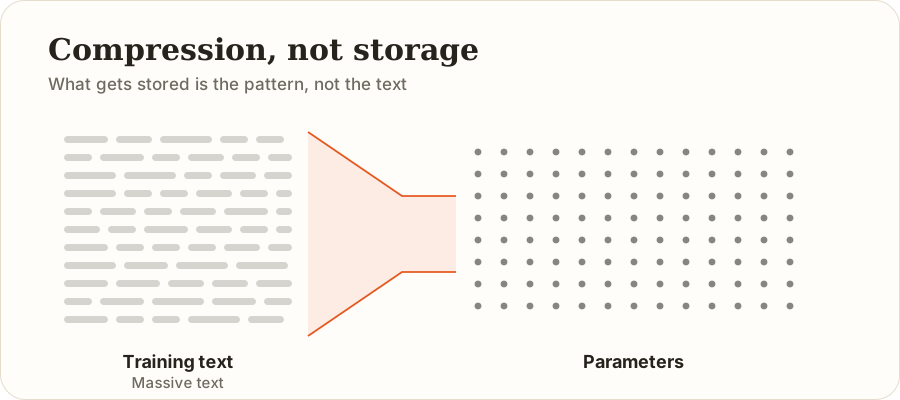
Across a massive body of text, the model doesn’t just pick up which words go together — it also absorbs grammar, narrative structure, question-and-answer formats, different writing styles, translation correspondences, and coding patterns. Training doesn’t stack web pages into a database one by one; it compresses the regularities found in that text into the model’s parameters.
Once it has absorbed enough of these regularities, the model can transfer a style of expression from one domain to a completely different task — turning raw notes into a polished email, or translating a dense explanation into plain language. But broad coverage and factual reliability are two different things. It knows exactly how a biography “should” read, without necessarily knowing the real birthdate of some obscure historical figure.
2. Context Can Make It Look Like It’s Learning New Skills On the Spot
Two concepts worth knowing here:
- Few-shot learning — the model doesn’t need to be retrained; if you just give it a couple of examples inside your prompt, it can often pick up the pattern and continue the task on its own.
For example, say you want the model to sort customer feedback into "Product Issue" or "Service Issue." Give it two examples first:
"The app keeps crashing" → Product Issue
"Support hasn't replied in three days" → Service Issue
Then feed it a third line:
"The refund page keeps failing to load" → ?
Based on the pattern in the first two examples, the model will likely classify this as a Product Issue.
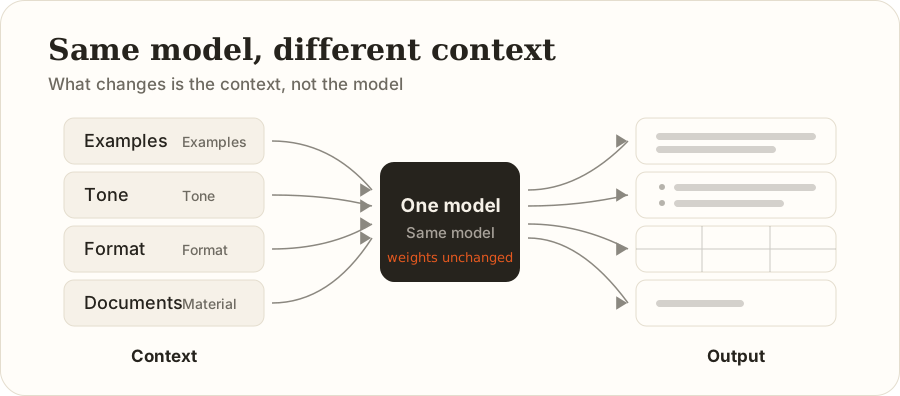
- In-context learning describes the broader phenomenon: the model draws on everything present in the current conversation — the stated goal, background material, examples, tone, and formatting requirements — to adjust how it responds on the fly.
For example, the same model looking at the same meeting transcript could do several different things:
- Asked to "pull out three key takeaways," it produces a summary;
- Given a sample meeting-minutes format, it mimics that structure;
- Given a few examples pairing tasks with owners, it might go on to extract action items;
- Asked to "explain this in language a non-technical person can follow," it drops jargon and adds explanation.
This “new ability” isn’t the model suddenly learning a new subject, and it isn’t retraining its own parameters mid-conversation. More precisely: it already had a vast library of language patterns on hand — it just didn’t know which one applied to this particular task. The examples and context you provide give it a temporary frame for the job.
But this ability has limits. The clearer your examples, and the closer the new task is to patterns the model has seen before, the more stable the result tends to be. If your examples are vague, too few, or too different from the new task, the model can misread the pattern entirely. It’s recognizing and extending a pattern within the current context — not building a verified new body of knowledge.
3. Why It Feels Like It’s Speaking to You Personally
The same underlying model, given a different person, ends up with a different context, a different stated goal, a different tone, different examples, and different system settings. So the probability calculation that follows lands somewhere different too.
Don’t read “it adapts to everyone differently” as “it has many separate personalities.” A better way to put it: this is one generation system that adjusts its phrasing and the path it takes depending on the input conditions. It might use technical jargon with an engineer, switch to an everyday analogy with a student, and emphasize business impact with an executive — but that’s not the same thing as the model knowing any of these people personally.
4. Hallucination: The Other Side of the Same Mechanism
Fluency and Truth Are Not the Same Goal
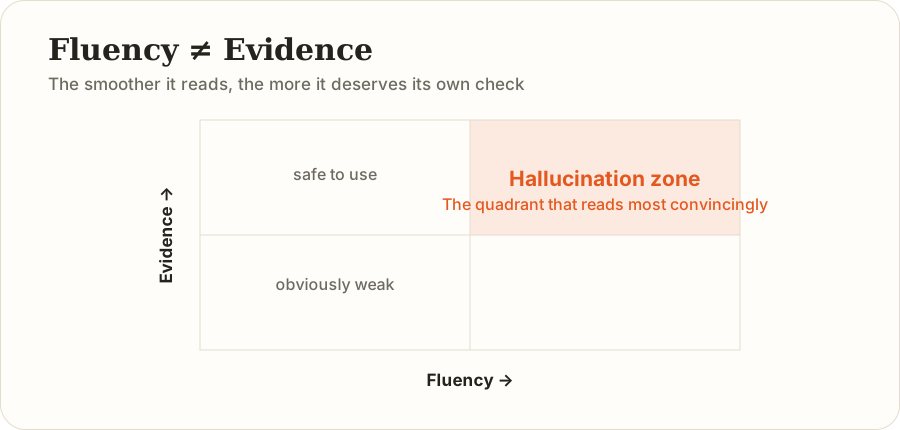
When generating a response, the model is mainly computing: which token is most likely to follow the current context. It has no built-in tag that marks a sentence as “verified.” So it’s entirely capable of continuing to answer even when it’s effectively uncertain — producing something that reads as confident and detailed, and simply isn’t true.
NIST’s generative AI risk framework uses the term “confabulation” — a model confidently generating false or fabricated content, often complete with a plausible-sounding explanation, logic, or citation to back it up. The more familiar term is “hallucination.”
Hallucination isn’t a random glitch. It’s a mismatch between the goal of generating fluent language and the goal of verifying facts. Something that reads smoothly is not automatically something that’s true.
Why Specific Details Are the Most Dangerous Part
Common grammar and high-frequency phrasing show up constantly in training data, so those patterns are stable. An ordinary person’s birthday, the details of some obscure event, or something that just happened in the news — these often lack that same density of stable pattern.
That sets up a counterintuitive scenario: an article can read beautifully overall while a specific name, date, number, or citation buried inside it is simply wrong. People tend to mistake polish for reliability — and polish is exactly what this mechanism is good at producing.
Why the Same Question Can Get Different Answers
Getting a different answer to the same question twice doesn’t mean the model has moods — it means the generation conditions were different, because word selection is inherently probabilistic. Changes in context, system settings, sampling parameters, or product-level design all shift the probability distribution over candidate tokens.
For creative writing, that variability can be a feature. For law, medicine, finance, or fact-checking, it’s a risk.
Being Connected to the Internet Doesn’t Mean the Model “Remembers” New Facts
It’s worth keeping four things separate: information baked into the model’s parameters during training, material you supply yourself, live search results, and results returned by tools. A web search can add outside material to the current answer — but that’s not the same as saying that material has been written into the model’s parameters, or that it automatically becomes something the model can recall in future conversations.
5. The Safety Problem Is Bigger Than “It Got the Answer Wrong”
NIST’s generative AI risk framework lists confabulation, data privacy, harmful bias, information integrity, information security, intellectual property, and human-AI configuration as distinct risk categories.
Information Risk
Wrong facts, fabricated citations, and outdated information can distort learning, professional judgment, and external communication. The more polished and official something sounds, the more likely people are to skip checking it.
Privacy Risk
A chatbot may come into contact with your input, internal company documents, conversation history, and whatever tools return. Exactly how a given product retains data, whether it’s used for training, and who inside the company can access it — check that product’s current policy directly.
Permission Risk
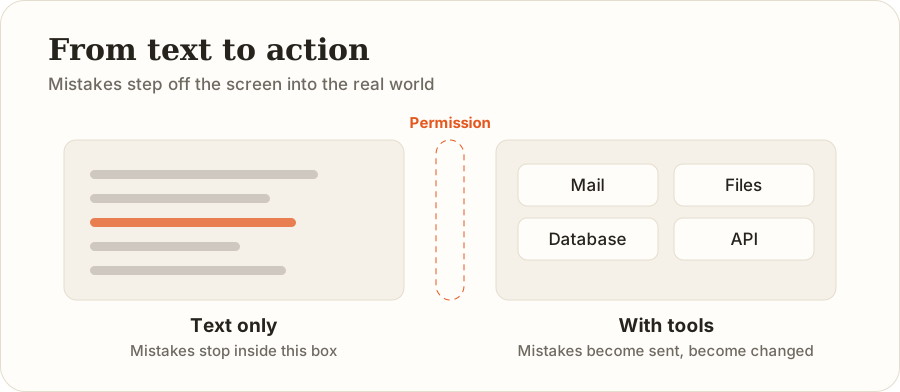
When a model only outputs text, mistakes stay on the screen. Once it’s connected to search, files, databases, email, a browser, business APIs, or a code execution environment, a mistake can turn into a real-world action. This is exactly why moving from chatbot to agent changes the risk profile: the question is no longer just “might it get this wrong,” but “if it gets this wrong, can it go ahead and act on it.” Permissions, human sign-off, logging, and result review all need to be configured in advance.
Harmful Bias
The model learns language patterns from a huge volume of human-written text — and human text is not clean. It can carry gender bias, regional bias, racial bias, occupational stereotypes, or long-standing neglect of certain groups. What the model absorbs isn’t just “facts” — it’s also how those things get talked about and linked together in language.
For users, this can surface in a few places:
- Hiring and evaluation: the model might more readily associate certain jobs, traits, or leadership qualities with a particular gender, age, or background;
- Education and content recommendations: it might explain mainstream examples more thoroughly while offering thinner coverage of minority groups, less prominent regions, or smaller languages;
- Customer service and decision support: it might interpret and respond to different phrasing styles inconsistently;
- Image and text generation: it might default repeatedly to the same appearance, occupation, or family-role assumptions.
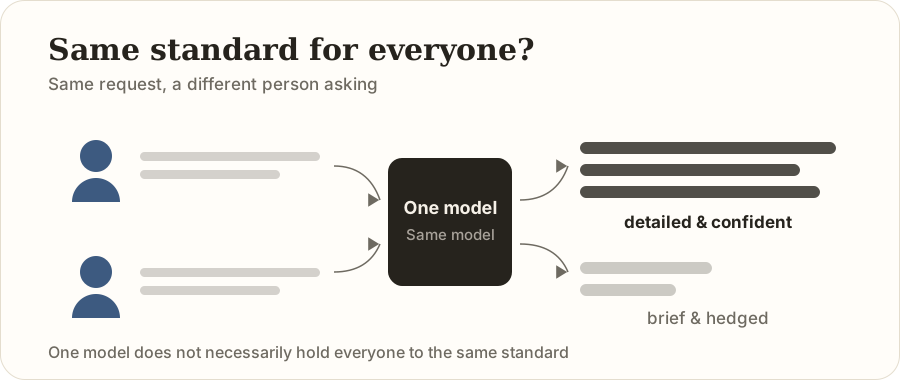
So bias risk isn’t just “the model said something offensive.” The subtler problem is that across a huge volume of ordinary answers, it may consistently describe certain people as more credible, more professional, more worth helping — and describe others as more suspect, less important, or simply invisible.
The question isn’t only “is this sentence clearly wrong?” It’s also:
Is it applying the same standard to different kinds of people?
In hiring, lending, healthcare, education, insurance, and public services, model output should never be the sole basis for deciding someone’s opportunity.
Human–AI Configuration
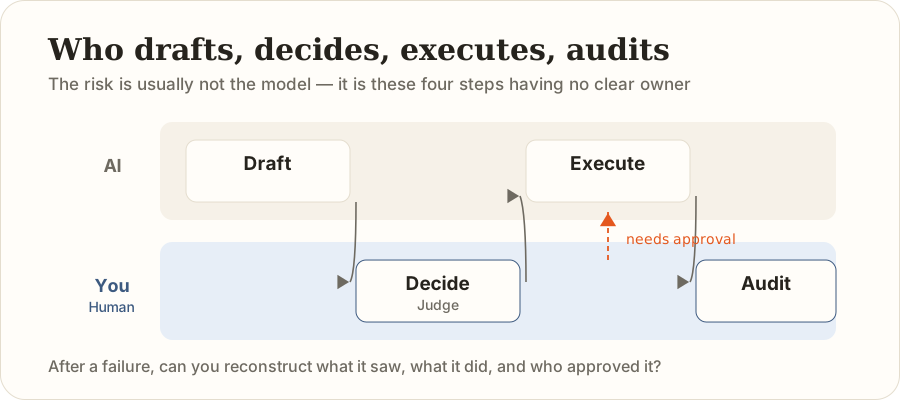
“Configuration” here doesn’t mean a software setting — it means the working relationship that forms between a person and the AI: who’s responsible for judgment, who’s responsible for execution, when the human checks in, and which of the human’s decisions the machine is allowed to influence.
The risk usually isn’t the model acting alone — it’s something the human and the system produce together.
The first time a model gives a wrong answer, the user is likely to catch it. The real danger is when the model performs smoothly enough, for long enough, that the user starts checking less — gradually treating “what the model said” as “roughly how things are.” This is automation bias: an inappropriate level of trust placed in the machine.
It can lead to a few consequences:
- Blurred accountability: something goes wrong, the user says “the AI gave me that answer,” and the organization has never established who’s actually supposed to review it;
- Weakened independent judgment: employees stop thinking it through themselves, and instead look at the model’s suggestion first, then work backward to justify it;
- Errors amplified at scale: one flawed template gets copied into hundreds of emails, thousands of records, or a huge batch of customer interactions;
- Mistaking politeness for reliability: a steady tone and a complete-sounding explanation lead users to assume the fact-checking has already been done;
- Skills quietly atrophying: if people stop verifying, calculating, and writing things themselves over the long run, they may have lost the ability to do the task independently by the time the model actually fails them.
So the key question in human-AI collaboration isn’t simply “should AI be involved here or not” — it’s designing four things up front:
- Which work can the model draft directly;
- Which judgment calls must be made by a human as the final decision;
- Which actions require human sign-off before they can be executed;
- When something goes wrong, can you trace back what the model saw, what it did, and who approved the result.
This is also why “make the model smarter” isn’t the answer to every problem here. The system also needs to clearly define: when to trust it, when to constrain it, and when a human needs to take over.
That’s a thread we’ll pick up again in later pieces in this series.
6. So How Should You Actually Use It Going Forward?
First, Sort Out the Nature of the Task
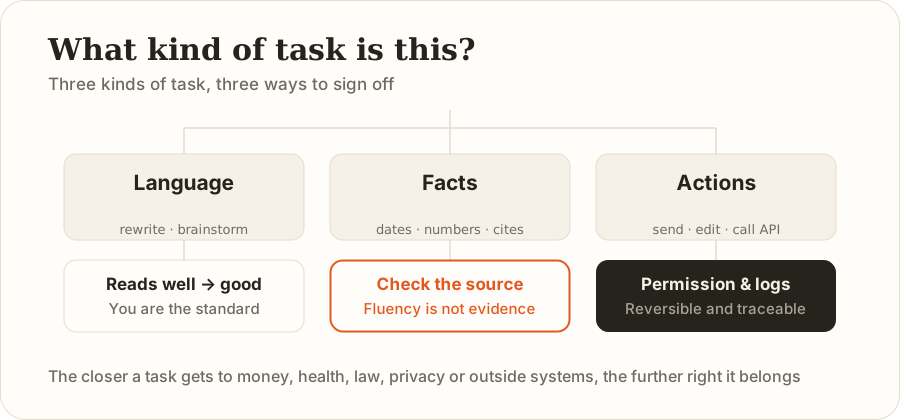
Are you asking it to help you draft something, brainstorm, or rephrase a sentence — a language-leaning task? If it produces something that reads well, it’s usually good enough to use. Or are you asking it to confirm a fact, run a calculation, or look up a data point — a fact-leaning task? However fluent and confident the answer sounds, you can’t take it at face value. You still need to check the original source, or verify it with a calculator or a search tool.
Second, Separate “Sounds True” from “Has Evidence”
Tone, length, technical vocabulary, and polished structure are not evidence. The more specific a name, date, number, or citation is, the more it deserves to be checked on its own.
Third, Don’t Settle for a Single Pass on Anything Important
Rephrase the question, swap in different source material, or ask the model to lay out its assumptions and uncertainties first. Getting inconsistent answers doesn’t necessarily mean one of them is wrong — but it does tell you this isn’t something you can settle by fluency alone.
The closer a task gets to money, health, law, privacy, or external systems, the more it needs sourcing, permissions, logging, and human sign-off.
A large language model’s capability comes from massively compressing language patterns and flexibly generating from them. Its limitation comes from the exact same place: it can package “I don’t know” so it looks exactly like “I know.”
Understanding this isn’t about putting AI down. It’s about no longer mistaking the ability to generate for the responsibility to judge.
Which raises the question our next piece picks up: since the model depends so heavily on context, how do you actually have a more effective conversation with it?